


You bought a fountain pen. Wonderful! But how do you fill it with ink? Don't worry, it isn't hard, and I'll explain in simple terms the easiest way for new fountain pen owners to get started. The deep-dive answer, though, may be more interesting and complicated than you think.
Did you know there are more than thirty different kinds of fountain pen converters? Modern fountain pens may also be filled using built-in piston, vacuum, pump-vacuum, or crescent-filling mechanisms, not to mention eyedropper filling! Let's take a look at all the different ways to fill contemporary fountain pens, along with some of the most popular pens designed to use each system.
In Part One, I'll cover cartridge/converter pens and piston fillers. Next week, I'll be back with Part Two to explore the rest!
Cartridge/Converter
The easiest and most convenient way to fill a fountain pen is with a cartridge: a disposable tube of ink that is simply pressed into the pen's section (the part you grip while writing), used until empty, then removed and replaced with a new one.
The majority of modern fountain pens accept cartridges, and your first fountain pen is pretty likely to be one of these, such as a Pilot Kaküno, Explorer, or MR (also known as the Metropolitan); a LAMY Safari or AL-Star; a Platinum Preppy; or a Kaweco Perkeo or Sport.
However, most pens that accept cartridges can also use a converter. This type of pen is known as a cartridge/converter, or C/C, pen. "Converter" is short for "cartridge-converter," because it converts a cartridge-filling pen into one that can be refilled from an ink bottle again and again. Like a cartridge, a converter is a removable ink reservoir, but it includes a built-in filling mechanism for drawing up ink.
 [Pictured: Lamy AL-Star pens with cartridges and a converter.]
There is nothing wrong with using cartridges for convenience, but a converter is more economical, better for the environment, and opens you up to almost limitless ink colors! A converter can be a little messier than a cartridge, but it can really enhance your enjoyment of your fountain pen.

[Pictured: a handful of different kinds of converters!]
Classic Piston Converters
Most converters contain a piston inside a plastic chamber, and are operated by turning a knob at the end counter-clockwise to advance the piston, then clockwise to reverse it and draw ink into the chamber. When I'm explaining converters in the store, I often compare it to sucking up a drink through a straw.

[Pictured: filling my Sailor 1911 through its converter.]
You can fill a converter when it's outside your pen if you want, but it's more efficient to first insert it into the section of your pen instead of a cartridge, then use the converter to fill the pen through the nib. That way, the nib and feed are already saturated with ink and ready to write once the converter is filled.
There are a lot of twist-style piston converters, and many brands use proprietary cartridges and converters, so, for those pens, you generally need to use a converter from the same brand as the pen.
Brands that generally require proprietary cartridges and converters include:
- Aurora
- Cross
- LAMY
- Parker
- Pilot
- Platinum
- Sailor
- Taccia (uses Sailor-manufactured nibs and requires Sailor cartridges and converters)
- Sheaffer (except the VFM, which uses Standard International cartridges and is too narrow to accommodate a converter)
- Waterman (some models with wider barrels can accept Standard International cartridges)

[Pictured: Aurora 158-C, LAMY Z28 (with two small protrusions on the sides that guide it into notches found on entry-level LAMYs), LAMY Z27 (fits all LAMYs), Parker, Pilot CON-40, Platinum (also comes in silver), Sailor (also comes in gold, mini length, and colors), Sheaffer, and Waterman.]
Most other pen brands will accept Standard International cartridges, including cartridges sold by Diamine, Graf von Faber-Castell, J. Herbin, Kaweco, Montblanc, Monteverde, Pelikan, Visconti, and Waterman. These cartridges all have the same size opening and will usually be compatible with most Standard International pens, but keep in mind that many pens are too small to accept Standard International Long cartridges and require Standard International Short cartridges instead.
So, can pens that take Standard International cartridges all share the same converters? That would be nice, but the answer is NO!
Although many European and American brands can share Standard International cartridges, that doesn't necessarily mean a Standard International converter from a different brand will fit well. Converters are less flexible than cartridges, and it's very important to get a good seal between the converter and your pen's section to avoid leaks. And even if a converter's opening is compatible, it may not fit inside the barrel of the pen.
For example, although Graf von Faber-Castell pens can use other brands' Standard International cartridges, you should stick with a Graf von Faber-Castell converter because the narrow barrel design is not wide enough to accommodate the turning mechanisms of most generic converters. When possible, it's best to select a converter from the same brand as your pen. Some brands, like Sailor, Kaweco, and Pilot, even have different converters to accommodate models with different barrel sizes.
Standard International converters include Faber-Castell, Graf von Faber-Castell, Kaweco, Monteverde, Pelikan, Visconti, and more. As you can see in the photo below, they are more uniform in appearance, and some brands offer both standard and deluxe versions.

My co-worker Joy, who is great at finding a converter to fit tricky pens, says she always tries the Faber-Castell Design or Visconti converters first when confronted with a Standard International pen that doesn't have a specific assigned converter. If those are too tight, she tries the Monteverde Mixer push-in converter, which will often fit pens with a narrower opening.
Monteverde also makes several other converters, including a threaded version (not pictured). Because some pens have a threaded opening on their grip section, they require a screw-in converter rather than a push-fit one.
And, if you really want to get fancy, a few brands, including Sailor, Kaweco, and Platinum, also offer converters in more than one color to better match your pen!
More Unusual Converters
Kaweco's tiny Foldable Mini Converter, which was designed for Standard International pens with very short barrels, uses a piston, but it operates with a plunger mechanism rather than a screw knob. To use it, just unfold the handle and push the piston in until it stops. Then immerse your nib in ink and pull the piston back out to draw ink into the converter. This type of mechanism is known as a syringe filler.

[Pictured: Kaweco's Foldable Mini Converter with the handle unfolded and plunger pushed partway down, installed in a pink Kaweco Sport pen. The blunt syringe pictured works the same way!]
The Foldable Mini Converter fits pocket pens that require Standard International Short cartridges, including the Kaweco Liliput, Kaweco Sport, Kolo Tino, Schon DSGN Pocket Six, and Benu Pixie. When using it with very short pens, make sure you remember to fold the handle back before reassembling the pen! If you don't, the end of the barrel will push the piston into the converter's ink chamber, and ink will shoot out of the nib! This only happened to me once, and fortunately it was on my kitchen counter, so it was no big deal and I just wiped it up.

[Pictured: the full Kaweco Foldable Mini Converter, handle folded, alongside a Standard International Short cartridge and the Kaweco Liliput.]
The Esterbrook Niblet also comes with a syringe-filler converter sized to fit pens that use Standard International Short cartridges, although the Esterbrook version isn't a super-small folding converter like Kaweco's.
As with many other filling systems, the best way to achieve the most complete fill with these converters is to draw ink up through the nib, then push the piston forward again to expel the ink along with excess air, allowing more ink and less air to enter on the next fill. Once you've done that, pull the piston back again to draw up more ink. You may need to repeat this process a couple of times to achieve the fullest possible fill.
Occasionally you'll also come across converters that don't use a piston.
Simple squeeze converters, like Pilot's CON-B (included with the MR collection), have a flexible sac that looks like a tiny balloon made of silicone or rubber, enclosed within a rigid housing to which a spring-steel press bar is attached. Pressing the bar squeezes the sac to push out air, and releasing it sucks in ink. For a good fill, you'll need to press and slowly release the bar two or three times, waiting a few seconds between squeezes. Our Pilot representative, Bill, tells me that on the third squeeze, he usually presses the bar just enough to push out the remaining air. This creates more room in the sac for ink and helps achieve a fuller fill.
The CON-B is gradually being phased out in favor of the piston-style CON-40, and if you don't enjoy using yours, you can always switch, or even clean and refill your empty ink cartridges with a syringe like the one pictured above.
Aurora's Model #158 converter, designed for Aurora's extra-slim models, is another aerometric/squeeze-style converter that uses suction to draw in ink. It fits pens like the Hastil that are too slender to fit a standard piston converter.

[Pictured: Pilot MR with CON-B installed, and Aurora's squeeze-style converter made for its extra slim models.]
Pilot's cartridge-converter fountain pens with larger barrels usually come with the high-capacity CON-70 (either in silver or in black), which uses a pump-vacuum filling mechanism. It works with a spring-loaded plunger. Pressing the button forces air out of the chamber, and releasing it quickly creates a vacuum that draws ink into the converter. To get a complete fill, press the button several times in quick succession. The inexpensive Kaküno and Explorer don't come with a CON-70, but you can buy one separately, and their wider barrels are large enough to accommodate it. The CON-70 holds about twice as much ink as the CON-40, and even more than a Pilot cartridge, so it's a great addition to those two pens!

[Pictured: my Pilot Custom 845 (center) with the black version of the CON-70 installed, and Pilot Kaküno, ready to connect up with a silver CON-70.]
When in doubt about which converter will fit your pen, be sure to do some research or ask. As you can see, there are a lot of different converters available, and sometimes even more than one kind of converter within the same brand. They are not freely interchangeable.
How To Use A Converter
In general, to use a converter, you'll need to:
1) Disassemble the pen by taking off the cap, then unscrewing the grip section from the barrel.
2) Attach the converter to the pen, if it's not already installed.
You might find a converter included in the box with your pen, sometimes hidden underneath a tray in the packaging. If your pen doesn't come with one, you can usually buy a compatible converter separately, but, as we've discussed, be sure to choose one designed to fit your pen.
Insert the converter into the open end of the grip section. Depending on the model, it will either press in and be held by friction or screw into place. Make sure it is fully inserted to create a good seal and prevent leaks.
3) Open your bottle of ink.
4) Flush the air from your converter (such as by advancing the piston or squeezing the converter to push out as much air as possible before filling).
5) Dip the nib into the ink bottle. You'll need to immerse it at least up to the breather hole (if your nib has one), but the easiest way is usually to submerge the entire nib in the ink. Depending on the bottle and how much ink remains inside, you may not always be able to see the nib while filling. If you dip it in a little too deeply, it's okay! You can wipe any ink from the grip section with a paper towel or soft cloth.
6) Once the nib is submerged, use your converter to draw up the ink. The converter probably won't be completely full of ink. This is normal, so don't worry that you're doing something wrong. If you'd like to fill the converter more fully, you can repeat the process, but a little air will probably still remain. It's also okay not to fill the converter all the way if you want to switch inks more often!
7) Remove the nib from the ink, and wipe off any ink from the grip section. Make sure you don't forget the area where the nib emerges from the grip section. It's fine for ink to remain on the nib, though.
8) Reassemble the pen, and you're ready to write! (Remember to replace the cap on your ink after you're done filling the pen, so you won't knock over the bottle and make a mess.)
Most of these steps will also apply when you move on to using built-in filling mechanisms!

[Pictured, back to front: Sailor Professional Gear with converter, Pelikan M200 with built-in piston, Pilot Custom 823 with vacuum filling system, TWSBI Diamond 580 with built-in piston, and LAMY Vista with converter.]
Piston Fillers
Although most people nowadays use a cartridge/converter pen before trying a fountain pen with a built-in piston mechanism, piston fillers were actually introduced long before cartridges and converters became widespread in the 1950s and '60s.
In the early days, fountain pens filled using pressure and lever mechanisms or an eyedropper, but they were inconvenient to fill and could be very messy. But in 1929, Pelikan introduced its revolutionary new differential spindle gear filling mechanism. This technology used two different screw threads inside the pen to allow the spindle to move more quickly than the piston knob. It was based on patents purchased by Günther Wagner from Hungarian engineer Theodor Kovács.
 [Pictured: a completely clear Pelikan M805 Demonstrator with its internal parts labeled, loaned to me by my friend David Fu, who also took this photo.]
Pelikan's first trendsetting piston filler was an immediate sensation, and the piston filling mechanisms used today work the same way they did when Pelikan introduced this invention in 1929. I was a little nervous about trying a piston filler before I bought my first Pelikan, but it's actually extremely simple to use. In fact, the mechanism works exactly the same way as the piston in a converter. The difference is that it is built permanently into the pen's barrel, turning the entire barrel into the ink reservoir, so this kind of pen can hold a lot more ink than a cartridge/converter pen!

[Pictured: TWSBI Eco fountain pen with instructions for filling and disassembly/reassembly.]
You can see how the mechanism works if you have a piston-filler with a transparent barrel, or if you disassemble your pen, like my TWSBI Mini in the photo below. Most piston-fillers are not intended to be disassembled, however, and you should not take one apart unless your pen includes the necessary tools and instructions.

A TWSBI makes a great first piston filler--or even a first fountain pen--because they are fun, affordable, and easy to use, especially the Eco model. They are very popular in our store, and many people love them so much that they collect multiple colors. It's fun to pick a matching ink, fill your pen, and watch the beautiful color swash around inside the barrel, especially if you're using a shimmering ink. It's also very cool to be able to fill your pen directly from a bottle without needing a cartridge or converter, a feature more commonly available in higher-end pens.

How To Fill Piston Fillers
To fill a piston-filler, first gently twist the knob at the end of the pen counter-clockwise (to the left) until it stops. This moves the piston forward, toward the nib. You can actually see how this works with a transparent model like the TWSBI Eco or Diamond, Monteverde MP1, Nahvalur Original, Pilot Custom Heritage 92, and some Pelikans.

[Pictured: Pelikan Golden Beryl M200.]
Next, simply submerge the nib in a bottle of ink and smoothly turn the knob in the reverse direction to draw ink into the reservoir. This moves the piston away from the nib, creating suction that draws ink into the pen. You can repeat this process if you want a more complete fill.
Pelikan suggests that you should allow three to five drops of ink to drip back into the bottle after filling your pen. This allows excess ink to flow back out of the ink regulator, and too-wet writing and ink dripping into the cap will be avoided. This is a great tip, although I usually forget to do it!
Turn the nib upright and continue to slowly turn the knob to release any remaining air from the pen. The knob should come to a stop and be flush with the pen. If there is any excess ink on the grip, you can wipe it off with a soft cloth or paper towel.
If you have a piston filler with a clear or translucent barrel, you can hold the pen up to the light to see both the mechanism and how much ink is in the reservoir. If the barrel is opaque, it's a little more mysterious, but many piston-fillers have an ink window below the grip section to help you gauge when it's time to refill. And, like any other pen, you will know to refill when your ink starts skipping and your pen won't write any more!

[This is my own pen, a Pelikan Souverän M400 Tortoiseshell-White.]
Cleaning the pen is just as easy! Simply submerge the nib in a glass of lukewarm water and turn the knob slowly in both directions to draw clean water into the pen and dispel the remaining ink and water in the ink reservoir. Just use plain water, with nothing added. Repeat this process until the water being dispelled from the pen runs clean. It only takes a minute or two.
Piston Passion
I love piston-fillers, especially Pelikans, which are some of my favorites in my own collection. Other classic piston-fillers include the Lamy 2000, Montblanc Meisterstück 149 and 146, and Aurora Optima (another one of my own favorites), along with the Pilot Custom Heritage 92, Sailor Realo, Kaweco Piston Sport, TWSBI Diamond, Delta Duna, and Leonardo Momento Zero Grande 2.0. To start with a budget friendly piston-filler, go for a TWSBI Eco, Nahvalur Original, or Monteverde MP1.

[Pictured: Custom Heritage 92, a 14k gold nib demonstrator that is also Pilot's only piston-filler.]
Although I've been using a lot of transparent and translucent piston-fillers in my photos to show you the mechanism inside, I don't want to give you the impression that all piston-fillers are see-through. Most higher-end models, like the majority of Pelikans and Montblancs, the LAMY 2000, the Sailor Realo, and the beautiful Aurora Optima, have only an ink window (or are completely opaque), though some brands occasionally release special-edition demonstrator models.

[Pictured: Aurora Optima in Burgundy Auroloide, the same color I own.]
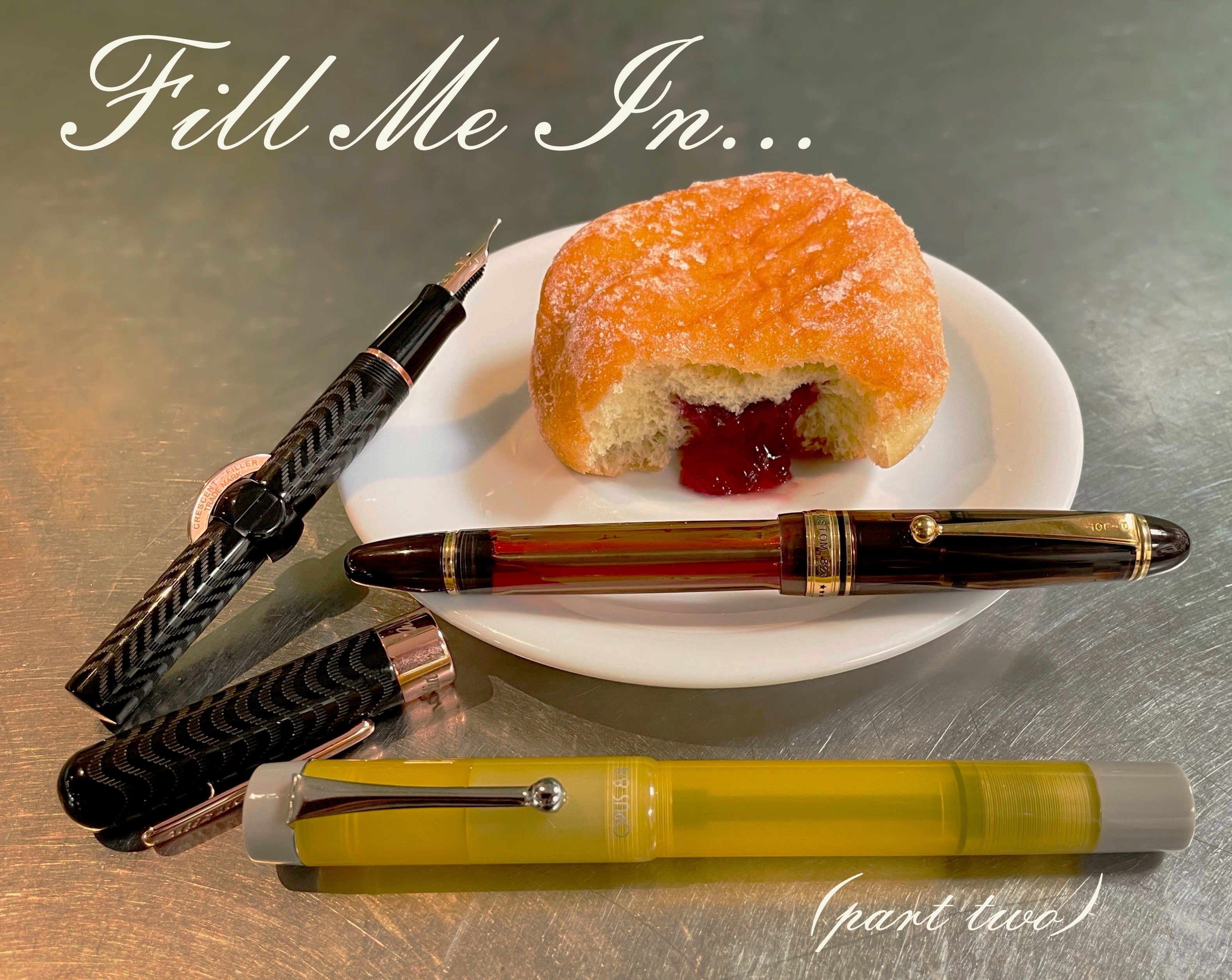
By the way, if you're wondering about this week's cover photo, it was inspired by a dream I had the morning I started working on this article. In the dream, I was photographing pens with different filling mechanisms posed next to a filled doughnut. When I woke up, I knew I had to make that dream a reality. (Yes, I dream about these articles. What can I say? Fountain pens are my obsession!)
It's been very interesting learning more about converters, and thinking more deeply about their relationship to pens with built-in filling mechanisms. I had never made the connection between piston-style converters and piston fillers like Pelikans and TWSBIs, even though it seems obvious now.
Next week, I'll teach you some vacuum-filler tricks and feature a pen with a built-in filling mechanism that works the same way as a Pilot CON-70, so be sure to come back for the exciting conclusion! I'll dive into vacuum fillers, pump-vacuum fillers, crescent fillers, and eyedroppers. See you then!
-Laura P.
I love comments on my blog! Please leave comments if you like the articles, and, if you have any questions about this article, or any of the other blog articles, you can e-mail support@penboutique.com. Thank you!
 [Pictured: Pelikan Souverän M1000, one of the biggest and best piston-fillers!]

5 comments
Lynn
Awesome blog! So much information. Thank you. You never disappoint.
Awesome blog! So much information. Thank you. You never disappoint.
Lita
LOVE this helpful column! I thought I might have to sign into something before commenting. I had a piston filler TWSBI but the piston part stopped working at one point, just got stuck and wouldn’t move. I’m looking for a durable but easy-to=use fountain pen with either converter or piston.
LOVE this helpful column! I thought I might have to sign into something before commenting. I had a piston filler TWSBI but the piston part stopped working at one point, just got stuck and wouldn’t move. I’m looking for a durable but easy-to=use fountain pen with either converter or piston.
Patrick
What a great article! So comprehensive! It covered a lot! Everyone could learn something new here, even if they own pens with all those filling systems!
What a great article! So comprehensive! It covered a lot! Everyone could learn something new here, even if they own pens with all those filling systems!
Laura P. (blog author)
Thank you for your comment, Frank! The Parker 61 sounds cool! This article series only covers modern fountain pens, though. There are a lot of interesting vintage filing mechanisms that I had to leave out.
Thank you for your comment, Frank! The Parker 61 sounds cool! This article series only covers modern fountain pens, though. There are a lot of interesting vintage filing mechanisms that I had to leave out.
Frank
You forget Parker 61, which literally. drew the bink into the filling tank by stickng in the back of the pen into the ink bottle
You forget Parker 61, which literally. drew the bink into the filling tank by stickng in the back of the pen into the ink bottle