
The Kolo Tino Story
At Pen Boutique, I get to see new pen colors, new pen models, and even new nib options on a pretty regular basis, but it's very rare to get to know a whole new pen company. The Kolo company was founded in 1998 as the house brand for Itoya Topdrawer, a prestigious lifestyle store in the world-renowned Ginza shopping district in Tokyo. Topdrawer now has beautiful boutiques in upscale, walkable, creative neighborhoods in Boston and the surrounding area, New York, Chicago, and Northern and Southern California. They carry mostly their own house brands, along with a few hand-selected others. Their products are all timeless, refined, and intentional--things like handcrafted Japanese handkerchiefs, washi-paper wrapped portable watercolor sets, and minimally designed leather watch bands. Kolo goods, from house shoes, to bags, to small leather accessories, photo albums, scrapbooks, and chic sunglasses, are carefully conceived and made using their own raw materials.
In late 2025, Kolo unveiled a new product line: the Kolo Tino, a stylish ballpoint and fountain pen created by Tino Valentinitsch, a prominent industrial designer from Vienna, Austria, and Peter Dunn, the founder of Kolo. The Tino is a sport pen, akin to the Kaweco Sport, but made with brass fittings combined with raw brass, raw aluminum, and special artisanal acrylics created in a very small shop in Northern Italy.
Scott Hammer, our Kolo representative, told me that the shop where the bespoke acrylics are handcrafted by Italian artisans is "so specialized that the owner will not allow photos of any kind," and that, normally, their acrylics are used for premium home furnishings and shop displays by "well known high-end designers and luxury brands." Working closely with Kolo to create unique patterns for their resins, the artisans produce sheets which are then turned into rods for the pens' bodies at the same facility.
The pens are then manufactured in Austria and the Czech Republic, using high-end Japanese CNC (Computer Numerical Control) machines which normally make very specialized medical instruments and specially milled parts for companies such as luxury car manufacturers. Their tolerances are at 1/50,000 millimeters. Their nib assembly, quality control, and final polishing before packaging is done by hand.
A Special Size and Shape
The first thing you'll notice when you pick up a Kolo Tino is the unusual, clever, and lovable size and shape. The ballpoint starts out as a hexagon, and tapers to (essentially) a triangle, while the fountain pen is an irregular hexagon with a wider bottom side, and feels like a triangle when you hold it. All of the corners are rounded and polished, and feel very nice moving between your fingers. The flat surfaces are perfectly angled to help you hold the pen and to prevent it from rolling without the need of a clip or roll stop, even on a tilted surface. Three sides feature lines subtly engraved in the body, diagonally angled on the triangle's slanted sides, and straight across its flat base. These lines are a subtle detail, but they provide your fingers with traction, and also give the pen a sporty flair and add to its Art Deco styling.

[Pictured: Kolo Tinos in Albert Blue, Wasabi, San Marzano, Anodized Aluminum Noir, Cabaret, Raw Brass, Dune, and Mother. The Leuchtturm 1917 notebooks are my own.]
Like other sport pens, the Tino is designed as a highly durable and compact everyday carry (EDC) pen that can be safely thrown into your pocket or bag with your keys and money, ready for on the go use whenever you need it. You can see it pictured below (in the limited edition Mother acrylic variant), on the far left in this lineup with the Kaweco Sport, Montblanc Baby, Monteverde Axis, Kaweco Liliput, Traveler's Brass, and Benu Pixie fountain pens. Its size is similar to these other pens, but its chunky, smoothly faceted shape feels particularly nice in your hand.

And, because the Tino's cap posts on its short brass end finial, overlapping very little with the body of the pen, it grows to a very comfortable length for writing. The pens' tolerances, made precisely to Kolo's specifications, allow it to be posted lightly, yet stay on securely. It does not need to be, and is not designed to be, pushed on hard, and will be difficult to pull off if you do so. A Tino fountain pen is 4.3" long with the cap on, and 3.9" uncapped. With the cap posted, it's about 5.5".

Tino has a long grip section compared to most of these other pens, and thanks to the cap's very secure friction fit, there are no threads to dig into your fingers or require tedious on and off screwing to remove on either end.
If you have large hands, or just prefer the balance or feel, it is also comfortable to hold the Tino further back, on the four diagonal lines engraved in the body. My friend Eric owns a brass Kolo Tino fountain pen, and he prefers to hold his pen in this area rather than at the grip section. Eric's hands are much larger than mine, and, for him, the weighty brass pen's balance is nicer that way. He also likes being further away from his writing surface, which gives you the feeling that you are writing with a larger nib.

[Pictured: Eric holding the Tino fountain pen in Raw Brass with his preferred grip. The lighter weight acrylic San Marzano and Raw Aluminum pens are in the background.]
Like Eric, I enjoy holding the pen at the "gills," but, in my medium-sized woman's hand, it also feels good held at the grip section. The flat side of the pen's cap--a rounded triangle--rests very comfortably against my hand as I write, and the balance feels perfect, whether it's the brass bodied version of the pen or the lighter aluminum or acrylic ones.

I even like how the pen feels without the cap posted, for quick doodles and notes! It's very short, but it snuggles in the crook of my hand in a way that feels relaxed and cozy.

The ballpoint version of the pen is very similar in size to a Kaweco Sport ballpoint, but its modified triangle shape is different and special. The Anodized Aluminum Noir variant is pictured to the right, below, with Montblanc Baby and Kaweco Sport ballpoints.

The ballpoint feels great in the hand! The push button mechanism is super smooth and quiet, similar to a Caran d'Ache ballpoint. Scott says it's perfect for fidgeters! I agree. It's just the right size and shape to fold into your closed hand and click away, either with your thumb or index finger. The compact size isn't designed for long writing sessions, but is ideal for quick notes and scribbles. The angled shape is very maneuverable (again, fun to fidget with by rolling and rotating it between your fingers) and I can easily reach the push button without having to reposition the pen in my hand while writing. It's fast to operate and just feels intuitive. Tino Valentinitsch and Peter Dunn conceived the Tino as a "quiet symphony of form and function," and it really does have a lovely rhythm, with a very satisfying shape that needs to be experienced to fully appreciate.

One interesting quirk you may have noticed about the Tino is that the Kolo logo is upside down from the point of view of the user, unless you are left handed. My left-handed co-worker Pierce loves this. Scott hasn't been able to find out why the pen was designed this way, but I have a theory. As you can see in the photo above, the name is written in the correct orientation from the perspective of someone facing the user. Perhaps, because Kolo is a designer brand, the logo is intended to be seen by others. Here's a photo of me holding the fountain pen, taken from the viewpoint of someone sitting across the table from me at a coffee shop. Clearly, I must have great taste, since I'm using a Kolo Tino!

Specs and Options
The Tino is available in both standard and limited edition variants, and we currently have ten different ones. The Raw Brass is one of the standards and is Tino's best seller. People love the satisfying weight and extreme durability of brass, and its warm, timeless look. Raw brass, an alloy of copper and zinc, is left in its natural state without a coating, so its shiny color will age and darken naturally, and develop a patina that's unique to you as the metal responds to your touches. It can also be polished repeatedly to maintain its high sheen. I was surprised and pleased to discover that the brass Tino doesn't have a strong smell, unlike other brass pens I've tried.
The brass Tino fountain pen weighs 67 grams empty of ink, and the brass ballpoint is 68 grams. They are quite attractive and have a very solid feel and satisfying weight. I love that the end finial and nib are a contrasting silver color.

Mother and Dune, the limited edition Tinos, are also extremely popular. These special acrylic blends are inspired by mother-of-pearl and the warm, earthy tones of desert landscapes, respectively. The creamy Mother acrylic has a vintage white Bakelite look, and Dune is slightly translucent and will hold the sunlight. They are more expensive than the solid acrylics, but each one is unique. Kolo has new limited edition bespoke acrylics on the way this April, and they are also very nice. I was able to see some sneak peak photos, and I am a fan.

The acrylic pens are significantly lighter than the brass, with a weight of 21 grams for the empty fountain pen, and 29 grams for the ballpoint. However, their brass fittings and solid construction still give them a nice balance and substantial feel. This acrylic definitely doesn't feel like cheap plastic, and even the plain colors are sophisticated and slightly unusual. Pictured below are Albert Blue, Sunny, and Wasabi, with some of my Kartos stationery.

You can see the other colors, San Marzano (a deep warm tomato red) and Cabaret (a dark plummy wine red), in my photo below, along with the Raw Brass, Raw Aluminum, Wasabi, and Albert Blue pens.

The Raw Aluminum and newer Anodized Aluminum Noir variations are a little heavier than the acrylic pens, but still much lighter than the brass. The Raw Aluminum fountain pen is 28 grams, and the Anodized version is 31 grams. (I didn't bring home ballpoints in these materials, so I couldn't weigh them.) Every Tino comes with a strong and snug cotton case, which you can see in some of my photos. It can be used to protect the pen, and also has a great handfeel! I love how the stiff tabs at the opening can flip back to allow easy access to your pen.

[Pictured: Raw Aluminum Tino fountain pen with my Rhodia Rhodiarama notebook.]

[Pictured: Anodized Aluminum Noir Tino fountain pen, with my TRAVELER'S notebook.]
Larger Kolo "Parker" cases are also available for purchase separately, and can hold a lot of Tinos (or other pens). They are sturdily constructed from 100% wool and come in various colors and stylish tweed patterns. The material is stiff and holds its shape, and has a great texture! I love the smooth metal zipper, leather zipper pull, and soft 100% cotton lining with carefully finished seams. The construction is impeccable.

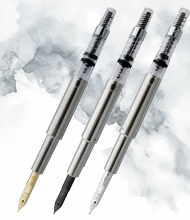
The ballpoints use a D1 refill, available in different colors and line widths from a number of brands. The fountain pens take standard international short cartridges, which are very convenient and are the easiest size to find. They are available from many companies, including Kaweco, Diamine, Graf von Faber-Castell, Monteverde, Pelikan, Montblanc, and more. You can also use a blunt syringe to refill the cartridges with bottled ink if you want to use other ink brands. A tiny Kaweco foldable mini converter will also fit! Each Tino fountain pen comes with one standard international short cartridge.

The Tino fountain pen uses German-engineered Schmidt #5 nibs, which they describe as "playful, wet, and great writers out of the box." It only comes in medium, and the one I tried was, indeed, a very smooth and wet writer, with personality and subtle line variation between the down stroke and cross stroke.

I enjoyed writing with an acrylic Tino for a few days while I was working on this article, and, while I would personally prefer a finer nib size, I think it's a very friendly nib and I loved the feel of the pen in my hand and its overall usability.

Tino is just such a nice shape, feels so smooth and solid, and is both stylish and fun. I am excited to see the new colors that will be coming out soon, and to watch how the Tino will develop in the future!
-Laura P.
I love comments on my blog! Please leave comments if you like the articles, and, if you have any questions about this article, or any of the other blog articles, you can e-mail support@penboutique.com. Thank you!