


In the modern world of fountain pens and inks, we have a myriad of options when it comes to color, from subtle and dreamy pale mauves, to intense and vibrant cheerful oranges, to swirling glittering hypnotizing rainbows, and everything in between. I love color, and I love being able to express myself with my color choices, but I also appreciate the absence of color... aka black. There's just something about the crispness and elegance of black. Black tie, black cars, black and white film, black leather... all have a je ne sais quoi that appeals to our sense of style.
I feel the same way about black pens, and was delighted to be able to sit down with Paul Erano, vintage fountain pen expert and founder of the Black Pen Society (BPS), during a relaxed after hours gathering at last weekend's Philly Pen Show, to talk about our shared love of black pens and what makes them special. Our conversation was wide-ranging, and we continued it over the phone a few days later. I was left with a feeling of optimism and excitement about the future of the fountain pen community, the Black Pen Society, and, of course, those beguiling black pens themselves.
 [Pictured: blog author Laura Petix with Paul Erano, founder and Grand Poobah of the Black Pen Society.]
Classic Elegance
I started my conversation with Paul by asking, "What makes black pens special?" After a moment of reflection, he told me that they appeal to him because they are understated, beautiful, and elegant, and he loves that when you look at a black pen you have to focus on the pen itself and not be distracted by all the colors.
"I may not seem it, but I'm more reserved," he confided, and I agreed... I am, too. Yes, Paul is the fez-wearing Grand Poobah for life of an ever-growing eccentric fountain pen society whose annual meeting is full of humorous pomp and circumstance, so he's no stranger to attention, but, as I discovered in our quiet one-on-one conversations, he's also thoughtful, creative, intelligent, hard-working, focused, reliable, and respectable, all qualities I admire and associate with black pens. Like the BPS's founder, black pens exude confidence, calm composure, and effortless cool.

[Pictured: Pilot E95s, a long-short pocket pen whose legacy goes back to the 1960s, when it was introduced as the Elite. E95s' buttery smooth inset nib, refined vintage look, and excellent price point make it my top recommendation for first gold nib fountain pen. We have trouble keeping this graceful beauty in stock!]
Paul explained to me that, when collecting the early vintage pens, people go looking for colorful ones, because any pen that has vivid color and is in excellent condition and not faded is worth a lot more money. "But I never really cared about that. I just liked what I liked. And I liked black pens."
Even before founding the Black Pen Society, Paul used to bring his Waterman Taperite with a solid gold cap to the local Hudson Valley pen club that he started back in the '80s. It was his favorite black pen at the time, and he remembers showing it to someone at a meeting. "The guy said to me, 'Oh, that's a beautiful pen... too bad it's black!' and I said, "You gotta be kidding!"
Agreed! In my own personal collection, I have ten solid black pens and I love them all. I try not to choose pen collection favorites, but, if I'm honest, several of my black pens are definitely among my most treasured and most reached-for, including my Pilot Custom 743 (his name is Sebastian) with a wonderfully expressive FA nib, elegant and precise Pilot E95s in Extra Fine, smooth and juicy classic Pelikan Souverän M405 in Fine, beloved workhorse Pilot Metropolitan in Medium (my first fountain pen), super stealthy Sailor Professional Gear Imperial Black in Medium Fine, and special Sailor 1911L with Naginata Concord nib, which is so much fun for sketching! (Yep, I penabled myself, thanks to writing a Sailor Bespoke Dealer Special Nibs blog article.)
 [Pictured: my own Pilot Custom 743, with a flexible Falcon nib. It's one of my two favorite pens and I carry and use it regularly!]
When I asked Paul about his very favorite black pens, he said there are so many really beautiful ones, it was hard to narrow them down, but named the Sheaffer Oversize Balance from the 1930s, Waterman No. 7, and Parker Duofold as vintage favorites, and the Waterman Man 100 as his most-loved modern black pen. Paul loves the way black pens like these are more subtle and refined than colored versions. Although vintage pens' barrels come in many colors and patterns, to Paul, the solid black ones are simply the most classic. I have to agree, there is something definitive and commanding about black.
Even in the world of modern fountain pens, with its dizzying array of materials and styles, plain black pens often rise above their colorful counterparts. The wonderful Pilot Custom Heritage 912 is available with fifteen different nib choices, but only comes in black, and my favorite Custom 743 offers almost as many nibs, but in black only. (Its special edition US Exclusive Verdigris variation, which will only be available for a limited time, allows six.)
 [Pictured: Pilot Custom 743 fountain pens with 14 different nibs available to try, at Pilot's DC Pen Show table.]
A modern day fountain pen with fourteen or fifteen different nibs to choose from is crazy cool, and allows you access to an incredibly diverse selection of nibs, from Posting to Waverly to Soft Fine to Coarse to Falcon to Music, and everything in between. No matter which nib you choose to express your unique handwriting, you can't go wrong with a sophisticated and timeless black pen body. It's like the perfect little black dress that's always in style.

[Pictured: Pilot Custom Heritage 912 in my hand.]
Similarly, Sailor makes its elite Bespoke Dealer Special Nibs, from Naginata Togi, to Cross Point, to King Eagle, available in plain black 1911Ls, distinguished only by their special rings. They look serious, elegant, and formal. On the surface, some people might even call them boring. But, underneath, they are some of the most interesting, exceptional, and fun pens I have ever had the opportunity to experiment with, and even my vintage pen friends were impressed when I encouraged them to try my Naginata Concord nib. (Paul used it to draw the unusual version of his Mr. Pen character in this article's cover photo!)
 [Pictured: Sailor's Bespoke Dealer Special Nib collection in all black, with Black Ion, Gold, and Rhodium trim options.]
When it comes to cool looking modern pens, one of most admired is definitely the Visconti Homo Sapiens, omnipresent in discussions of fountain pen lovers' "holy grail" wishlist pens. Yes, the Homo Sapiens is now available in all kinds of colors and materials, but it's the original Lava Bronze (or "Bronze Age") model--an incredibly durable, virtually unbreakable, heat resistant to 200° F, and slightly hygroscopic solid black amalgamation of basaltic lava harvested from Mt. Etna, ground to a powder and catalyzed with nylon resin--that is the most desirable. It's the classic, and is the pen most people picture when they hear the name Homo Sapiens. The Homo Sapiens has many other special features (check out my blog article on the pens to learn more!), but there is nothing quite like the smooth, but porous, matte texture, and surprisingly velvety feel of the black lava models.


[Pictured: Bronze Age (black with bronze trim) and Dark Age (entirely black) Homo Sapiens models.]
Other exceptional pens from Pilot and Sailor are available in extremely limited colors, but classy and classic black is always an option. They include Sailor's understated and dignified Ebonite King of Pens, Pilot's very impressive flagship fine writing pen, Custom Urushi (with its famously bouncy #30 nib), and the magnificent and huge solid glossy paragon of the Roiro Urushi lacquering artistry technique, Namiki Emperor Urushi Black (also available in Urushi Vermillion).
 [Pictured: my co-worker, Harsh, holding a black Namiki Emperor.]
Equally beautiful, but not oversized, are Custom Urushi's sophisticated and super smooth smaller Urushi lacquer sibling, the Pilot Custom 845 (my personal favorite, and you can read more about it in my "Attainable Urushi" blog article!), and the lovely Namiki Yukari Royale Urushi Black, with a larger #20 nib. (Since this is a black article, we won't mention the Vermillion versions of these pens!)
 [Pictured: Pilot Custom 845 in Black and Vermillion. They are both gorgeous, but there is something especially elegant about the black one!]
Sailor's Lefty fountain pen, with a 21 karat gold nib designed especially for left-handers, only comes in Black or Maroon, but my left-handed teammate Pierce, a college student in his early 20s, doesn't mind. He loves black pens and proudly carries his Sailor Lefty, Sailor 1911 Trinity, vintage Pelikan 120, and Montblanc 149.
 [Pictured: Pierce's Sailor Lefty 1911L in Black.]
The Montblanc Meisterstück, arguably the most famous fountain pen in the world, does come in a few other colors beyond black, but those come and go. Black is the archetype, and will always be the most popular. At the Philly Pen show, I asked Jimmy Dolive, entrepreneur and beloved pen show fixture, if he has any favorite black pens, and he immediately named the Montblanc 149, saying, "There's something a little funny about a Montblanc 149. There's something mystical about it when you put it in your hand, even to look at it. It makes you think about it." A calm and beatific look came over his face as he added in his charming Georgia accent, "Better than any medicine is putting your 149 in your hand and doodling with it. It makes my blood pressure drop."
 [Pictured: Jimmy Dolive with me at last year's Philly Pen Show. If you get a chance, stop and talk to Jimmy about pens, or about my latest blog article. He's one of my favorite regular readers. Thanks, Jimmy!]
BPS and the Resurgence of Fountain Pen Collecting
There's definitely something to what Jimmy Dolive says. Even if it's not a Montblanc 149, using a beautiful and dependable fountain pen, especially one that appeals to your personal sense of style, can be a calming ritual that helps you focus and shut out the noise of the overstimulating modern world we live in, something that more and more collectors have been discovering over the past decade, ironically largely due to fountain pens' small but growing presence on the Internet.
But it's often when fountain pen lovers are able to meet in person that the magic really happens, and this is part of what makes brick-and-mortar stores (like Pen Boutique), pen meetups, pen shows, and social groups like the Black Pen Society so important. Collectors who meet in person can learn from one another, pass on knowledge, share their enthusiasm, and connect with like-minded people who may seem different on the surface but discover they have much in common even beyond a love of fountain pens.
I joined the Black Pen Society last March at the Baltimore/Washington International Pen Show, thanks to an introduction by vintage pen guru Myk Daigle, a "Duke" in the society. Myk and I had become friends through after-hours gatherings at pen shows, and I was honored to interview him on our YouTube show, For Your Penjoyment. When I stopped by his MaD Mercantile table at the pen show for a calming break from an overstimulating morning, Myk told me how much he was enjoying reading my blog articles, and that I should meet fellow writer Paul Erano and join the Black Pen Society.

[Pictured: Myk Daigle at the Detroit Pen Show showing off the Sugar Turtle Studio Leila For Your Penjoyment sticker I had just given him from my co-host Leila. Note the BPS pins below his pen show badge!]
I was a little intimidated, but Myk brought me over and introduced me to Paul, and, after I declared my love for black pens and handed over $5 for an enamel BPS lapel pin, I was a member! The showroom was busy, so we didn't have a lot of time to talk that afternoon, but I immediately liked Paul, who has been collecting fountain pens for more than thirty-five years and is a fixture at pen shows from coast to coast. Although he's starting to cut back a little, he still attends over 10 shows a year as a vintage pen dealer, and, in addition to being the founder and Grand Poobah of the BPS, is the author of two highly respected books on the hobby, Collecting and Valuing Fountain Pens and Fountain Pens Past and Present. He is also the publisher of The Fountain Pen Journal (FPJ), a lively and intelligent magazine dedicated to the art of vintage and contemporary fountain pens, now in its tenth year and going strong. Paul told me that he, like me, loved writing creative fiction when he was younger, then discovered that he could use his skills and knowledge to write about fountain pens and gain a wider and more appreciative audience.
I'm not a joiner, but the Black Pen Society is my kind of club: quirky, tongue in cheek, and with only one (totally optional and very unconventional) meeting per year, which takes place at the Washington DC Fountain Pen Supershow in August. I attended my first meeting at the 2025 DC Pen Show, and even did my duty and brought two new members to join. After all, as Paul Erano freely admits with a twinkle in his eye, the BPS is basically a pyramid scheme! It started with only two members over twenty years ago, ballooned to almost a hundred at their first official meeting in 2010, and expanded exponentially from there, as each member found more black pen lovers from all around the world to invite.

[Pictured: my friends/inductees, Pierce Rose (my Pen Boutique teammate, very enthusiastic lover of black pens, and budding vintage pen collector) and Bill Pearcy (our Pilot rep), joining the BPS during the annual meeting at the 2025 DC Pen Show. Pierce wanted to get his pin at the meeting to make it even more special, and BPS Duke Greg Proctor was happy to assist.]
What started off as a "secret society" started by older white men with an offbeat sense of humor has become more and more diverse each year, just as the fountain pen hobby itself has. Everyone is welcome, and Paul loves seeing the influx of enthusiasm and creativity that has blossomed in the fountain pen community, especially over the past five years. "Change is good," he stated emphatically. A hobby that had started to become stagnant and in danger of dying has become vibrant again. Paul shared that the subscriber list to his magazine was originally all male, but now it's 50% female, and that he has seen the same refreshing change in pen shows over recent years. After I joined, I began to notice more and more people in the fountain pen community with BPS pins on their lapels, backpacks, purses, and pen show badge lanyards. We are everywhere! What started with 100 lapel pins has blossomed to 700 or 800 pins a year, and, in Paul's words, there are as many different types of members "as there are collectors." He added, "Which, of course, is the best thing about it."
While laughing with Paul over one of his amusingly officious Grand Poobah proclamations, I remarked that I just love that, while some people would consider black pens serious and boring, the Black Pen Society is fun. It's not a stuffy society at all. Paul immediately agreed, "Not at all. None of it's serious. Not a lick! Plus, we're loaded with color." I clarified, "You mean the members are loaded with color?" and Paul responded, "The members, the pins, our attitude...." We both laughed, and I added, "The meetings!" Black Pen Society meetings aren't secret, and you can find descriptions and probably even videos online that will give you an idea of what they are like, but I think it's more fun to be surprised, and I definitely enjoyed the weirdness of my first one.
More Favorite Black Pens
When I first had the idea for this article, I asked Pen Boutique owner, Leena Shrestha-Menon, what her favorite black pens in her personal collection are, and she immediately named her Montblanc Meisterstück 149 in Medium, Visconti Homo Sapiens Lava Bronze (which I talked about above) in Medium, Pilot Custom Urushi in Fine, and Lamy 2000 Makrolon in Medium. All classics!
I've already written a little about the Montblanc 149 earlier in this article, but I don't think it's an exaggeration to say that the Montblanc Meisterstück in black is the most well-known fine pen in the world, with a look and reputation that is famous even outside the fountain pen community. The iconic Montblanc snowcap emblem on the cap (introduced in 1913), and even the torpedo shape of the pen, are instantly recognizable and communicate that this pen is elite and noteworthy.
 Montblanc began using the name Meisterstück (it means “Masterpiece” in English) in 1924 for their best pens, and the Meisterstück 149 (Diplomat) model was introduced in 1951. The Diplomat, and its smaller siblings, the medium-sized 146 (LeGrande) and small and portable 145 (Classique), share a timeless look that will always be in fashion. The Meisterstück 149 was even the model for the pen emoji.
Yes, the Meisterstück is expensive... Montblanc is a designer brand. But it's also a great pen, a smooth and juicy writer with a gorgeous nib, and an heirloom that can be passed down for generations. There is something that's hard to beat about the feeling of having a Montblanc Meisterstück in your pocket or pen case, and this is a classic beauty that its owners love to use every day, both to make a statement to the world and also to enjoy that quiet luxury as an everyday part of their lives.
 If you'd like to learn more about the details and history of this pen, and why a Meisterstück is a great investment, check out my blog article on them! It was a fascinating one to write, and is full of black pens.
Another article I especially loved writing is my recent one about the pens that feature Pilot's famous #30 nib, and you can read all about Leena's third pick, the Pilot Custom Urushi, in that article. I feel like I didn't show enough photos of the black version of the Custom Urushi, so here's a new one. What a beauty! That hand-applied Urushi lacquer finish withstands corrosion from water, acids, alcohol, and temperature changes, and has a totally different feel in your hand than a resin or metal pen does. It is unmatched in its beauty and shine, and warms to your touch and has a depth of color that can't be replicated.

[Pictured: Pilot Custom Urushi in black.]
Leena's mention of the Lamy 2000 surprised me, just because it's not a pen I'd normally associate with her, but I guess it shouldn't have! Winner of design awards and beloved as a classic that has remained virtually unchanged since its introduction in 1966, the Lamy 2000 has a cult following as an everyday carry "workhorse" pen and is the pen that shaped the design principles and reputation that Lamy is known for today. This pen has a reputation and following that puts it in a truly elevated place in the world of modern fountain pens.
German industrial designer Gerd A. Müller took inspiration for his design from the principles of the Bauhaus and other German modernist schools from the early 20th century, creating a pen with a clean, minimalist look, and the original Lamy 2000 is made from Makrolon polycarbonate, a very strong fiberglass material, and features a stainless steel grip section.

Makrolon was developed by Bayer, and is used in many industries as an alternative to glass because it is so durable, impact-resistant, lightweight, and long-lasting. It can be made transparent (like in the pen's slim ink window), and is recyclable. The Lamy 2000 is wonderfully light in your hand, in a way that feels deliberate and remarkable, rather than cheap. The subtle texture of the surface has both aesthetic and functional benefits: it gives the pen a pleasing soft, matte look, hides fingerprints and scratches, and makes the surface more grippable. I love the way light reflects softly off the black surface, and the contrast between the pen's body and clip. It's so different from the other pens in this article, but perfect in its own way.
Another modern classic (it celebrated its 60th anniversary in 2023) is Pilot's Matte Black Vanishing Point, which is actually Pilot's most popular Vanishing Point! With 38 different Vanishing Point pens to choose from, what makes Matte Black the best seller? (Keep in mind that the Vanishing Point is also Pilot's best selling gold nib pen, so that means people really love it.) I was discussing this pen with a friend a few weeks ago, and she said, "I looked at the colorful ones, but I love that Matte Black so much. So classic." She told me she was planning to order it the next day. I agreed with her... matte black is special. It's stealthy, and almost velvety looking when the light hits it just right. Plus, the texture is wonderful, with a slight drag when you run your fingers along the barrel. It's easier to grip, and just looks cool. And, naturally, this pen goes with everything!

Of course, if you aren't into the Matte Black standard VP, there are six more solid black Vanishing Points to choose from: the Black with Gold trim and Black with Rhodium trim standard pens; the sophisticated wood Birchwood Black; luxurious Matte Black LS with Matte Black trim and Shiny Black LS with Rhodium trim; and the slimmer black Décimo, also with Rhodium.

[Pictured: Black with Gold trim Vanishing Point in my hand.]
When I was choosing great black pens to include in this article, I got a little out of control. It was very hard to narrow them down. I ended up with fifteen, but later realized even that was too many to actually write about, even though they are all special. When I talked about my struggle with Pierce, he tried to help, but agreed it was just impossible to kick out any of our favorites.
One of the less well known pens in my pile was Sailor's Ebonite King of Pen, and Pierce told me I should definitely keep that one, because it has been his grail pen since he started working at Pen Boutique. He says he loves it because it has a fair price and is attainable for him, because he likes the silver trim option, and because he is intrigued by ebonite because it warms to your touch, smells good ("like a tire"), and the color becomes a warmer shade of black over time as you use it. He wants to get one and watch it age. He also loves the feel of Sailor's King of Pen model in his hand, and says his appreciation for big pens has gone up since getting his Montblanc 149. "You feel cooler because it's a large pen," he added, laughing. "It feels like a pen a movie character would have." I love this reason! After all, black pens are fun, right?

The Ebonite KOP is Pierce's grail pick, but another one of my most admired black pens is the Waterman Carène, especially the Reflections of Paris edition. I don't own one yet, but I'd love to. This pen is just stunning. You can read more about it in my Intrigue and Elegance with Inlaid, Inset, and Hooded Nibs article. The word "carène" means "hull" in French, and the pen is designed to call to mind the hull of a racing yacht. Its shape just has a calm elegance that conveys an effortless sophistication and debonair charm.

You may question whether the Reflections of Paris edition of the Waterman Carène truly counts as a black pen, as the cap is palladium with gold trim, but I brought this up with Paul, and he assured me that he, as Grand Poobah, officially decrees that it's the black barrel that is most important, so, yes, it would be a lovely example of a black pen. Or, as BPS members like to say, "Black enough."
If you're a stickler, there are also solid black versions of the Carène, with either silver or gold trim. All its variations share the same streamlined, aerodynamic look, which makes it appear as though it's zooming through the water, parting the waves with ease. I love the curve of the clip, and the way it gracefully rises at the end, with a gentle sweep that feels wonderful to run your finger along. Of course, the super smooth inset nib is what makes the Carène truly special. As Waterman describes it, "The Carène's exquisite integrated nib complements its unconventional curved design and is crafted to glide effortlessly across the page."
 I have so many more favorite black pens I'd like to write about, and I took beautiful photos of some, so I don't want to leave them out...
There's the gorgeous Pelikan Souverän M600 Black with Gold Trim, the perfect size for my hand, and so lovely with that incomparably beautiful Pelikan clip and nib...

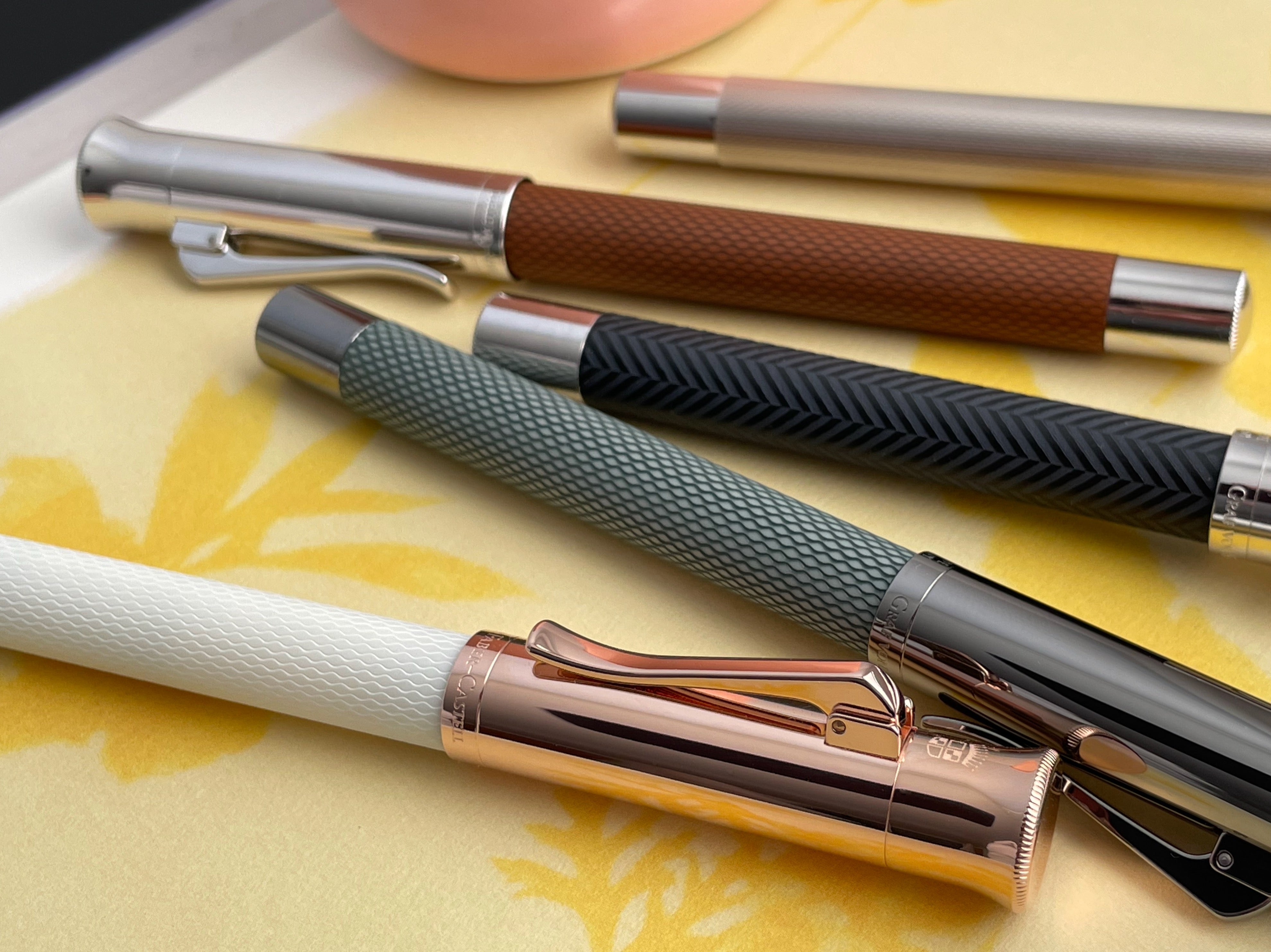
...the Graf von Faber-Castell Classic in Ebony Wood, which I can't omit, because it's the only wood pen featured in the article. (Plus, just look at it! Wow.)

...and what about the Pilot Metropolitan in plain black, the pen that started this whole fountain pen journey for me? You don't have to pay a lot for a reliable, smooth writing, and handsome looking black fountain pen! My black Metropolitan, Horace, will always be special to me.

And, when it comes to steel nib classics, what about the Kaweco Original? This full-sized Sport design pen comes in Black scratch-resistant anodized aluminum with chrome trim and is based on the design of Kaweco pens of the 1950s. There are two nib sizes, 060 or the huge 250. I love the octagonal shape, vintage look, and cool tin packaging!

There is one more modern classic I just can't leave out... the Montblanc StarWalker UltraBlack. You can read all about the StarWalker collection in my article, but suffice to say that I love how sleek and futuristic they are. The StarWalker is intended to appeal to a younger audience than the Meisterstück, or to anyone who wants something a little more daring than the classic cigar-shaped pen. It offers a very different look and feel, while still retaining the uniqueness and prestige of a Montblanc. I'm a big fan of science fiction and modernist design, so I can't help being attracted to the space age curves and lines of these pens that pay tribute to space exploration and our place in the universe. Of all the variations, the UltraBlack with Matte Black precious resin and black Ruthenium-coated fittings is the most effortlessly cool. I was recently talking with several regulars in the store who agreed that it is their dream StarWalker.
 [Pictured: Montblanc StarWalker in UltraBlack Doué, with Montblanc Sartorial one pen zipper pouch in Cassis.]
Black Pens are For Everyone
There are so many more great black pens for every budget and taste, including black TWSBIs like the Diamond 580 ALR and classic Black Eco, black Lamy Safaris, the sparkly black Nahvalur Original Plus Lovina Graphite, and even the cute Benu Pixie in Smoky Black. I'm sure you can think of many, many others.
As I wound up my Black Pen Society conversation with Paul, he remarked, "People think we like only black pens. But, no: we encourage people to like all pens. [And if you prefer] pens that are other than black pens, we just say: think about black pens, too! And if you like black pens, you like black pens. You don't have to like all black pens."
"No, of course not! But some people don't like black pens. They think black pens are boring, they don't appreciate black pens. Black pens are great!"
"Yeah, I have little empathy for them. I don't understand that, personally."
We laughed, and I remarked, "I mean, one of the great things about a black pen is you can match any color ink to it. Of course, you could do that with any pen, but some people like to be matchy-matchy about their pens and inks. That's not an issue with a black pen. The sky's the limit."
Paul chuckled, "That's another thing I never understood, but, I guess some people think it's fun."
"Yeah!"
"But yeah, you could use any color ink you want in a black pen, and it's okay. There's really not a heck of a lot to it. I've always liked black pens because they're so understated, and they're beautiful, and classic."
When I asked Paul to estimate what percentage of his own personal collection is black, he said, "I have no idea! I'm an opportunist. I don't go out looking specifically for a particular pen. What I love about the hobby is I love interacting with the people."
"Same."
"I love wheeling and dealing; I just like pen people."
Yeah.
"I pretty much have everything, and I like to have pens that go from $10 to $1,000, because not everybody can afford a thousand dollar pen."
Exactly! Pens are for everyone and can be enjoyed at any price point. Black, white, chartreuse, or puce. Fountain pens, and where they lead you, are wonderful.
If you'd like to meet Paul Erano and join the BPS, he's planning to be at eleven pen shows this year: Philadelphia, LA, Baltimore, Chicago, Raleigh, St. Louis, DC, San Francisco, Boston, New York, and Ohio. He has his BPS pins at every show, but the official meeting with the Grand Poobah's Ceremonial Fez is only at the Washington DC Supershow. "Yeah, I won't wear that thing more than once," Paul said dryly. Hahaha!

-Laura P.
I love comments on my blog! Please leave comments if you like the articles, and, if you have any questions about this article, or any of the other blog articles, you can e-mail support@penboutique.com. Thank you!


9 comments
Jay
I love the article. I have more than a few black pens in my collection. My favorite is a frankenpen that was created when the Page (Germany) pen’s piston stopped working but I loved the way the nib wrote. The FPH, NY matched the nib and feed (Bock 14K) with a Pelican 120 body. She writes like a dream with great flex and good balance in the hand. I have no idea who made the original pen. No one seems to know that manufacturer. It was also black with gold-plated cap band and clip. The Pelican 120 has a clear top-cap on the cap. I don’t know if that’s original or replacing a missing part.
I love the article. I have more than a few black pens in my collection. My favorite is a frankenpen that was created when the Page (Germany) pen’s piston stopped working but I loved the way the nib wrote. The FPH, NY matched the nib and feed (Bock 14K) with a Pelican 120 body. She writes like a dream with great flex and good balance in the hand. I have no idea who made the original pen. No one seems to know that manufacturer. It was also black with gold-plated cap band and clip. The Pelican 120 has a clear top-cap on the cap. I don’t know if that’s original or replacing a missing part.
Eric Arnold
Funny, I seemed to have had a very similar conversation with Paul at the Philly Pen Show. Currently I have three black pens inked, a Lamy Imporium, Esterbrook’s Raven, and a Waterman Safety from the turn of the previous century. A recent acquisition at the Detroit show should not go unmentioned, a Mondu in Ebonite, with a black and gold nib. That pen is gorgeous! While Viconti’s Homo Sapiens certainly fits, I’m surprised you did not mention their Alfred Hitchcock edition pen. Black pen, black humor, certainly a fine choice! I suppose there are just too many to name. Anyway, what a delight to see you feature this discussion with Paul, well done!
Funny, I seemed to have had a very similar conversation with Paul at the Philly Pen Show. Currently I have three black pens inked, a Lamy Imporium, Esterbrook’s Raven, and a Waterman Safety from the turn of the previous century. A recent acquisition at the Detroit show should not go unmentioned, a Mondu in Ebonite, with a black and gold nib. That pen is gorgeous! While Viconti’s Homo Sapiens certainly fits, I’m surprised you did not mention their Alfred Hitchcock edition pen. Black pen, black humor, certainly a fine choice! I suppose there are just too many to name. Anyway, what a delight to see you feature this discussion with Paul, well done!
Jim
Great blog, Laura! As an owner of a Montblanc 149 (black & gold), I really appreciated learning about the BPS. I hope to meet you at the DC pen show this year.
Great blog, Laura! As an owner of a Montblanc 149 (black & gold), I really appreciated learning about the BPS. I hope to meet you at the DC pen show this year.
Tom Teichgraeber
As the owner of five black pens I enjoyed this nice feature! You must have really been in a black mood when you wrote this.
As the owner of five black pens I enjoyed this nice feature! You must have really been in a black mood when you wrote this.
David J Holmes Sr
Wonderful, wonderful article, Laura. My first entry to the BP world was Levenger’s “True Writer” series, since discontinued. Bought the black, then the red, green and blue TWs. I have quite a few fountain pens but the black one has a presence of its own.
$ prevents a lot.
Wonderful, wonderful article, Laura. My first entry to the BP world was Levenger’s “True Writer” series, since discontinued. Bought the black, then the red, green and blue TWs. I have quite a few fountain pens but the black one has a presence of its own.
$ prevents a lot.
Lisa
I thoroughly enjoyed this article. I absolutely love black pens. I’ve never heard of the BPS, but I’m definitely joining this year and hope to meet everyone in DC this year. One of my favorite black pens is my Kaweco AL-Sport blackout edition. I especially love completely blacked out pens. And I am one of those who like to throw an UN-matchey color into them. Though staying classy with a dark blue, blue/black or black ink is enjoyable as well. I have been tempted by the Sailor KOP ebonite for several years. Maybe one day…
I thoroughly enjoyed this article. I absolutely love black pens. I’ve never heard of the BPS, but I’m definitely joining this year and hope to meet everyone in DC this year. One of my favorite black pens is my Kaweco AL-Sport blackout edition. I especially love completely blacked out pens. And I am one of those who like to throw an UN-matchey color into them. Though staying classy with a dark blue, blue/black or black ink is enjoyable as well. I have been tempted by the Sailor KOP ebonite for several years. Maybe one day…
Judy
Paul is such an amusing person. I’m very fond of him. At shows, I sometimes bring him a pen and he’ll say, “Judy, you’ve gotta quit buying so much junk.” Or, “You paid $65 for THAT?!” He’s apparently not an internet person, which makes it hard to communicate with him at times. As to the fez, it changes often, gets kidnapped, disintegrates, has journeys rather like that garden gnome or the traveling pants.
Paul is such an amusing person. I’m very fond of him. At shows, I sometimes bring him a pen and he’ll say, “Judy, you’ve gotta quit buying so much junk.” Or, “You paid $65 for THAT?!” He’s apparently not an internet person, which makes it hard to communicate with him at times. As to the fez, it changes often, gets kidnapped, disintegrates, has journeys rather like that garden gnome or the traveling pants.
Roger Penn
My favorites are either black or silver(ish) in gold trim. As I started reading this blog I had my black Metropolitan in my hand and couldn’t help grinning from ear to ear at your picture of Horace. I’ve had that 149 on my wish list for a while but really don’t see anyone buying me that for Christmas.
My favorites are either black or silver(ish) in gold trim. As I started reading this blog I had my black Metropolitan in my hand and couldn’t help grinning from ear to ear at your picture of Horace. I’ve had that 149 on my wish list for a while but really don’t see anyone buying me that for Christmas.
Gary Eggers
Great article! Very enlightening & entertaining. So many terrific choices to consider…
Great article! Very enlightening & entertaining. So many terrific choices to consider…