



Are you new to the world of fountain pens, and trying to choose your first one? Then this article is for you! I'll walk you through my recommendations, and help you pick the right pen to bring you joy rather than frustration as you begin your fountain pen journey. This is also a great article to read if you are selecting an introductory fountain pen to give to a friend or loved one.
First Things First
I've been using fountain pens regularly for over seven years now, and my years at Pen Boutique have given me the opportunity to become knowledgeable about a huge range of pens, both through writing in-depth blog articles and helping customers in the store. I still remember what it was like to pick out my first fountain pen, though. I was excited, but nervous, too, and I agonized about choosing the right one. I didn't live near a fountain pen store at the time, so I couldn't try the pen, and it seemed like an expensive purchase, when the felt tip and rollerball pens I had used in the past only cost a few dollars.
Yes, fountain pens cost more than disposable pens, but they are a sustainable purchase that can be refilled and used over and over. High-quality pens that are well cared for can last more than a lifetime! The experience of writing with a fountain pen is also completely different from using other types of pens and pencils, or typing on your phone or keyboard. Fountain pens feel more meaningful and relaxing. When writing with a fountain pen, you learn to slow down, loosen up, and focus on the simple pleasures of feeling your nib move lightly across the page, watching your beautiful ink glistening on the paper, and discovering how your handwriting expresses your unique personality. Writing with a fountain pen feels special. It is not just a generic office or school supply, but an intentional choice that expresses your style.

[Pictured: TWSBI Eco in Black Marble with Bronze.]
But, how do you know which pen to select? When a customer comes into our store looking for their first fountain pen, I don't want to overwhelm them. Yes, having a lot of choices to explore over time is wonderful, but there are so many options available, it can be too much when you're just starting out. When picking out your first pen, it's best to keep it simple. Like the Reddit discussion community member ryua said on the r/fountainpens subreddit, "It's not as scary as it seems. You can go as deep into the rabbithole as you want, or just stop near the surface."
My first fountain pen was a Pilot Metropolitan, and, if I had to do it all over again, knowing what I know now, I think I would still choose the same pen, because I have fairly conservative taste and I was looking for a reliable, high-quality pen that was attractive, serious, and timeless looking. However, I wouldn't recommend a pen from the Pilot's MR collection to every new user. In this article, I'll walk you through my top suggestions for first fountain pens, and help you narrow down the choices depending on your individual preferences. I'm not going to say any of the pens are "better" or "worse" than one another. Every pen I included is one that I think would make a good first pen, and it's up to you to choose what's right for you.

[Pictured: My first fountain pen, "Horace."]
Keep in mind that when you are first starting out, it can be hard to actually know your pen preferences yet, and that's okay. That's part of the reason that it's good to start with a "beginner" pen that is relatively inexpensive. You may end up trying a few different entry-level pens over the first few months or years, and that can help you explore which nibs suit your handwriting, which pens feel nicest in your hand, and which pen styles express your personality. Your tastes may also evolve over time. All of this is perfectly normal! But, if your first fountain pen is one that is reliable and easy to use, feels comfortable in your hand, and looks good to you, you will be a lot more likely to keep reaching for it and have a smooth and joyful fountain pen journey. Let's get started!
For each pen, I'll mention the retail price at the time of writing. Keep in mind that many of these pens are often discounted at Pen Boutique, so you will likely pay less than the retail price. Also, prices will go up over time, but I'll try to check back in and update the article periodically. In any case, the numbers will give you an idea of the pens' costs relative to one another.
Pilot Kaküno
A few months ago, I had the opportunity to give a new co-worker her first fountain pen. Yes, I often help customers in the store choose their first pens, but this felt different because I was selecting the pen myself and making the statement that this was my choice for her. I really wanted her to have a great first experience, and for it to be a pen that she'd enjoy using for years, but I also didn't want to spend a lot of money on it.
I wasn't expecting it would remain her one and only fountain pen, but I hoped it would be a stepping-off point that would make her fall in love with fountain pens and continue to explore on her own, while still coming back to that first pen as a reliable and lovable favorite, rather than something she would move on from and eventually discard.

[Pictured: Translucent Coral, Translucent Aqua, and Clear Pilot Kakünos.]
That's a lot to ask from one inexpensive starter fountain pen, but I think the Pilot Kaküno can fulfill my vision. Over the years, it has become my first suggestion when a customer comes into the store wanting to try their very first fountain pen, especially when they seem nervous about learning to use one or want to start at a very low price point. The Kaküno is exceptionally user-friendly, starts at only $15.00 for the six standard transparent-bodied models (Blue, Coral, Aqua, Pink, Green, and Clear), is a reliable and consistent smooth writer, and even has a gold-plated steel nib version called the Madoromi Collection with five soft translucent colors for $20.00, which writes even more smoothly. The Madoromi Collection pens are the only ones with a gold-plated steel nib in this article; all the rest are plain stainless steel. It's a subtle difference, but definitely noticeable if you compare them one after another.

[Pictured: Rosy Dusk, Nimbus Gray, Cumulus White, Twilight Periwinkle, and Azure Sky Madoromi Kakünos.]
Although I have a pretty big luxury fountain pen collection at this point, including several that cost over $1,000, I still enjoy using my own Kakünos. They just feel friendly in my hand. Yes, the Kaküno is made of lightweight plastic, and the shape is full of features designed to help new users, especially young ones, so it's not the most sophisticated or cool looking pen in the world, but, for me, it's like that simple but delicious comfort food I continue to return to even after learning to appreciate gourmet dishes. I think my co-worker feels the same way. She took to it right away, and, although she has acquired more expensive fountain pens over the months we have worked together, I still see her regularly using her Kaküno.
Kaküno means "to write" in Japanese, and was designed for children or for adults who can use a little extra joy and whimsy in their lives. Its most famous feature is the fun surprise under the cap: its classic Pilot steel nib is engraved with a smiley face, and there are actually several different versions of the smiley to choose from. To be honest, I don't really care one way or another about the faces on the nibs, and I usually don't pay a lot of attention to them. The pen itself makes me smile, even without the special nibs. But, the smiley face isn't just there to be cute. Kaküno's smiley nib is a feature designed to teach young or inexperienced fountain pen users to make sure the flat part of the nib is facing up when they write, which helps ensure proper contact between the nib and your paper for smooth, consistent ink flow. Seeing the cheerful and encouraging smiley looking up at them helps them know they are consistently holding the nib in the right direction. I love that even the name Kaküno itself includes a smiley face, on the "ü"! This is just a stylistic element for the name, not meant to be pronounced as an umlaut. Kaküno is pronounced KAH-koo-no.
 [Pictured: three steel-nib Kakünos and a gold-plated steel nib Kaküno from the Madoromi Collection. There are seven different smiley variations, depending on which pen you choose!]
Kaküno's subtly triangular-shaped ergonomic grip also guides you to hold the pen properly, and this is actually something I personally really appreciate. I have a tendency to turn my pen slightly outward while writing, and Kaküno helps correct for this, so I get better contact between my nib and the paper. Because the contoured grip section is so subtle, it is usually comfortable even for people who don't hold their pen with a standard grip and who find pronounced triangular grip sections to be awkward.

[Pictured: I'm right handed, but I'm holding Kaküno in my left hand for this photo. It's very comfortable for me in either hand.]
To help get newbies off on the right foot, the cleverly designed package also comes with a charming user guide in which Kaküno itself shows you how to enjoy your new pen! The step-by-step instructions, written in English, French, and Spanish, are extremely clear and user-friendly. I wish all beginner pens came with such great directions! The reverse side even has a diagram showing all the parts of the pen.

[Pictured: Kakünos with some of their wonderful beginner-friendly packaging.]
The Kaküno incorporates some other helpful features, too. The plastic barrel and cap have a hexagonal shape to keep the pen from rolling off your desk, with an additional bump on the cap in case the pen starts to get away from you, plus a groove for easy removal. Again, these features are wonderful for users who are less coordinated or aren't as careful, but they are handy for anyone!

[Pictured: grip section and contoured cap closeup. I love both!]
I love the shape of the Kaküno just because of the way it feels when I hold it. The faceted cap and barrel feel nice when I turn the pen lightly between my thumb and fingers, as does the juxtaposition between the smooth flat surfaces and curves. Its light weight (11 grams) makes this pen very comfortable for me to use for long writing sessions, and it's extremely well balanced, both with the cap set aside or posted on the back of the pen, so it's versatile for users with different hand sizes.
Like most other fountain pens, Kakünos come with one ink cartridge to get you started, and they refill with Pilot or Iroshizuku cartridges if you want to keep it simple. But, Kaküno has another great feature: it can accept both Pilot's CON-40 and large CON-70 converters if you'd like to fill your pen from a bottle of ink. The CON-70 converter holds a lot more ink and is easier to fill than CON-40, but doesn't fit in Pilot's shorter and slimmer pens. You need to buy the converter separately if you want to use one, but the pen is so inexpensive, it remains a great value.

[Pictured: Kaküno with a CON-70 converter installed.]
The Kaküno is available with three different nib options: Extra-Fine (EF), Fine (F), and Medium (M). For most new users, I'd recommend the Medium, but those with very small handwriting often prefer the Fine. The Extra-Fine nib only comes on the completely clear version, and most brand-new fountain pen users will find it a little too sharp feeling, although it's great for more experienced users who love very precise writing and drawing.
Kaweco Perkeo
The Kaweco Perkeo (pronounced KAH-veh-ko Pair-KAY-oh) isn't as well known as the Kaküno, but it's a fun alternative. It costs $20.00 for most colors, so it's a little more expensive than the Kaküno, but pretty similar. My friend Leila loves beginner pens, and she considers the Perkeo an "unsung hero." She also loves her Kakünos, but when I listen to her talk about her Perkeo collection, I can tell this pen just "resonates" with her a little more. When you're choosing a pen, there often aren't concrete reasons making one a better or worse choice for you... maybe the pen just appeals to you because of the shape, the color, the brand name, the country of origin, or even the name of the color! None of those reasons are silly!

[Pictured: Kaweco Perkeo in the "Bad Taste" colorway.]
Leila told me, "The first Kaweco Perkeo I purchased was in the colorway called 'Bad Taste.' It had a black barrel and a bright red/pink tone cap. And I loved the fact that it was called 'Bad Taste.' I got a medium nib and it wrote smoothly, and I couldn't put it down for the longest time. When I finally did put it down, I kind of forgot about it, kind of lost track of it, and ended up getting myself a second one with a fine nib... ooops. And this was like two years apart. [Then I] remembered how much I loved the experience of writing with that pen, even with the fine nib. From there, things kind of exploded. I went searching for all [the] colors... so I've been steadily amassing a collection. I love them. I love that I can be rough with them and they survive. They're so comfortable for me to write with. With the price point and the handfeel, the Perkeo ranks near the top of my beginner pen list."
She also mentioned that she really likes that the Perkeo uses Standard International cartridges, which means it doesn't need proprietary cartridges like Pilot, LAMY, Sailor, and Platinum pens (among others) do. The Perkeo can accept cartridges from many different brands, including Diamine, J. Herbin, Kaweco, Monteverde, Pelikan, and Waterman. When you're new to fountain pens, you may not want to use bottled ink right away, and that's okay! The proprietary-cartridge brands have plenty of great ink colors, too, but a Standard International pen gives you even more flexibility, and Leila appreciates that. Your Perkeo will come with one cartridge to get you started.
If you want to try bottled inks, Leila also noted that the Medium nib Perkeo can handle a shimmer ink surprisingly well, as long as you choose a brand with smaller shimmer particles. Shimmer inks from J. Herbin and Colorverse are the safest choices. (Don't use shimmer inks with Fine nibs, as they are very likely to clog the pen. I usually recommend Broad or Stub nibs.) To use bottled inks, you'll need a Kaweco Standard Converter, which is sold separately.

[Pictured: Perkeos in All Clear, Bad Taste, All Black, Peony Blossom, Breezy Teal, Cotton Candy, Old Chambray, Retro Block, and Jungle Green, with various Standard International cartridges.]
The Perkeo is a versatile pen that has so many different personalities. It comes in low-key variations like All Black, but also fun colors and quirky colorblocked combinations, plus the new Iridescent Pearl with a luminous translucent finish that shifts between blue-green and soft pink, depending on the light and angle. It's very hard to capture how pretty it is in a photo!

[Pictured: Perkeo in Iridescent Pearl.]
Like Kaküno, Perkeo also offers an entirely clear version for people who enjoy seeing inside their pens. There is even a Perkeo calligraphy set with three different nib and grip sections included, so you can swap between a 1.1 mm, 1.5 mm, and 1.9 mm stub to experiment with line-width variation. I wouldn't recommend that for your first fountain pen, because it's a little harder to write with a stub nib, but it's a great option to try later.
The Perkeo is about 1 gram heavier than a Kaküno. Both have snap caps, and both have nice facets and an anti-roll design, so they are very comparable. Neither pen comes with a clip, but you can buy a clip designed for the Perkeo, and, if you really want a clip for the Kaküno, the Kaweco Sport clips will fit it! The Perkeo's contoured grip section is a little more pronounced (although not as pronounced as the LAMY Safari's), and its facets have sharper angles, compared to Kaküno's very smooth, rounded shape, so the two pens have a different feel in the hand. To me, the Perkeo's shape and material have a "harder" feel, while the Kaküno feels "softer."

[Pictured: Kaweco Perkeo in "Cotton Candy" vs. Pilot Kakuno in Translucent Aqua.]
Lamy Safari and AL-Star
The next pens I'd show a customer would probably be either the LAMY Safari and AL-Star or the Pilot MR Collection (most often known as Pilot Metropolitans). Let's talk about the LAMY pens first. They have an unusual avant-garde design that didn't appeal to me right away, but, once I tried it, I loved it, and I now own several in different colors and with different nibs. I reach for mine often because they are so functional, fun, and comfortable to use.

[Pictured, front to back: LAMY Safaris in Charcoal and Pink, LAMY Vista (the clear Safari model), and LAMY AL-Star in Black Purple.]
If you're wondering how to pronounce the German brand name, LAMY, it's "Lah-me" (rhymes with "Tommy") but many people say "Lam-ee" (like a baby sheep) and both variations are easily understood!
The pens are very similar, which is why I've grouped them together. The chief difference is that the Safari ($37.00 for most models) is made primarily from very strong ABS plastic, whereas the AL-Star ($47.00 for most models) is a more premium lightweight durable anodized aluminum. The "AL" in AL-Star signifies aluminum.

[Pictured: LAMY AL-Star in Ocean Blue.]
The AL-Star is slightly larger than the Safari and also a little heavier (20 grams vs. 15 grams), and I personally prefer the feel and slightly more sophisticated look of the sleek aluminum to the plastic, but plenty of people like the warmer and grippier feel of the durable plastic, the lower cost, or the matte texture featured on some of the Safari colors. A red Safari was actually Pen Boutique owner Leena's first fountain pen, and I know a man in his mid-80s who eventually got rid of the rest of his pen collection--including expensive pens from brands like Montblanc and Pelikan--but kept his Safari. Some people really do develop a lifelong attachment to these pens! The Safari and AL-Star are both great pens, and it's a matter of personal preference, not which one is "better." They both have lots of color variations that range from serious and subdued to fun and vibrant, another reason why they are so popular!

[Pictured: Classic Red LAMY Safari.]
The difference in size is actually quite subtle. If you stand the two capped pens side by side, they are the same height, but the AL-Star is a little thicker, and its cap sits lower on the barrel when posted on the back of the pen. (Both pens are quite long when the cap is posted, so I often don't post mine, but it's balanced and comfortable either way.) Although both pens feature a brass clip, the Safari's is often coated to color-match the pen. The Safari's opaque grip section is made from the same material as the cap and barrel, while the AL-Star features a translucent grip section that allows you a glimpse at the inner workings of the ink feed.
Both pens use the same nibs, converters, and cartridges.

[Pictured: Pink Safari and Black Purple AL-Star.]
I really like the contoured triangular grip section, which guides your hand so that you will hold it correctly and get good contact with your nib on the paper. If you have an unconventional grip, you may hate it, but, for me, it's very ergonomic and comfortable. It's definitely more polarizing than the grip sections on the Kaküno and Perkeo.
I used to think the clip was a bit weird looking, but it has definitely grown on me. It's very sturdy and utilitarian, and that's what this German-engineered pen does best. I love to slip an AL-Star into the sleek pen sleeve that comes with some of the limited edition colors, and throw it into my bag so I have it with me wherever I go. It takes up hardly any space, and the pen is held securely in its case by the clip, yet slides out quickly and easily for a quick note or sketch.

[Pictured: several of my own AL-Stars, ready to draw.]
Another thing that appeals to people about the Safari and AL-Star is that you can get them with a lot of different nib options. Most colors will come with a choice of an Extra Fine, Fine, or Medium nib out of the box, but some also offer Broad and Left Hand options as well. You can purchase spare LAMY nibs separately, too, and they are easy to switch, although I don't recommend switching them regularly, because this will put unnecessary wear and tear on your pen. If you want pens with more than one nib option, most people will buy more than one pen rather than constantly swap nibs on the same pen. To learn more, you can read my blog article, A Complete Guide to LAMY's Interchangeable Nibs, but, for beginners, I'd recommend a Fine, Medium, or Left Hand (LH) nib.

[Pictured: AL-Stars with converter and cartridges.]
The Safari and AL-Star don't come with a converter, but you can buy one separately for only $6. One cartridge is included with your new pen to get you started. The converter in this photo is intentionally incorrectly installed so you can see the little tab that sticks out. That tab is supposed to slide into a thinner channel that you can see next to the U-shaped notch that faces up. Installing your converter correctly will lock it into place and ensure a snug fit with no leaks. You'll feel a satisfying click as it snaps into place!
Like Pilot's, LAMY's cartridges and converters are proprietary, so you'll need to stick with LAMY brand for those, although you can try any brand of bottled ink in conjunction with your LAMY converter.
Every year, LAMY releases special edition Safari and AL-Star colors. Each is produced for a limited time, and they are fun to collect. Standard colors like Black, Purple, and Ocean Blue stay in the regular lineup.

[Pictured: Special Edition AL-Stars in Turmaline, Lilac, and WhiteSilver.]
Whenever people see me out and about with one of my AL-Stars, they ask about the pen, and I show it to them gladly. I've had many people comment on how beautiful it is. That surprised me at first, but, yes... it's casual, approachable, reliable, a bit whimsical, avant-garde, quirky, cool... and beautiful, too, in a unique way.
Pilot Explorer
I often find that customers who aren't crazy about the LAMY Safari's unconventional-looking clip or don't like its triangular grip section love the Pilot Explorer ($32.50) as a more traditional alternative in the same price range. The Explorer is also less whimsical-looking than the Kaküno or Perkeo, so it's great for school or work when you want your pen to be a little more low-key.

[Pictured: Pilot Explorer ready to explore.]
The name "Explorer" has multiple meanings: it's an excellent introduction when you are just starting to explore the world of fountain pens, and its lightweight but sturdy resin construction makes it perfect for tossing in a bag or pocket when you're out exploring the world, because it doesn't weigh you down. This lightness inspired the name it goes by in the Japanese market: the "Lightive." It's also an excellent choice if you find the brass MR/Metropolitan too heavy or not comfortable for your grip. The Explorer weighs 6 grams, so it's even lighter than the Kaküno (11 grams) or Safari (15 grams) and much lighter than the MR (27 grams).
Speaking of grip sections, one reason die-hard Explorer fans love this pen is the extremely comfortable grip section, which is designed to be slightly grippy so your fingers won't slip. It's made from the same material as the more expensive Pilot MR's grip section, but is longer and has a much more gradual transition, so it's also a hit with people who find the metal step between MR's section and body uncomfortable.

[Pictured: Explorer in Matte Black in my hand.]
If you think you may let your pen sit unused for a long time, the Explorer also has an especially airtight cap, so your ink won't dry out as fast. This isn't a flashy pen, but it's very practical and reliable!
 Another big reason to love the Explorer is that, like Kaküno, it can accept both Pilot's CON-40 and large CON-70 converters as an alternative to Pilot's cartridges. The CON-70 is the highest-capacity converter we sell, and features a unique push-button vacuum-filling mechanism. It's easy to use and holds about twice as much ink as the CON-40, and even more than a Pilot cartridge. The Explorer comes with a converter and a Pilot cartridge to get you started, but if you want the CON-70 converter you'll need to buy that separately.

[Pictured: Explorer in Demonstrator Clear.]
I really enjoy writing with the Explorer, which uses the same great steel nib as the Pilot Kaküno and Metropolitan, and I find the weight, balance, and shape very comfortable. The snap cap posts securely on the back of the pen, and the barrel is also a nice length for writing with the cap set aside, if you prefer not to post your pens. I also really like the little round indentation on the Explorer's cap, which reminds me of the round window on a spacecraft. It gives the pen a space age feel, and I've always thought the pen resembled a little space capsule!

The Explorer currently comes in Matte Black, Demonstrator Clear, Matte Coral, Matte Navy, Matte Turquoise, and Matte Ivory, although you can still find some of the older colors in stock, including White and metallic Gold and Silver.
MR Metropolitan, Retro Pop, and Animal
I keep referencing the Pilot Metropolitan, so let's talk about it for real! As I mentioned, this pen was my very first fountain pen, and I still feel great loyalty to it to this day. After all, it was the pen that started it all! For me, the Metropolitan was the perfect introduction to the exciting world of fountain pens, and it led me on a journey that soon included gold-nib Pilot pens, more steel nib Pilots (because I liked them so much!), and eventually other brands as I explored further. I definitely don't regret taking that route, and I know I can always rely on Pilot's consistent attention to quality, the pens' tasteful elegance, and their incredibly smooth nibs that are a true joy to write with, at any price point. Yes, I love plenty of other brands as well, but I still lean toward steering people to Pilot because I think they are very reasonably priced and their overall collection has a wider variety of writing options than any other brand. That said, Pilot's style can be too reserved for some people, and going with a pen that appeals to your own sense of style is very important. You want your pen to represent you.
The pens in the Pilot MR Collection ($42.50), commonly known as Pilot Metropolitans, are sturdy and streamlined, with a brass barrel, contrasting polished stainless steel accents, and an ergonomic black plastic grip section designed to be slightly grippy so your fingers won't slip. Their nearly symmetrical shape looks modern and almost futuristic, but also timeless. As the "Metropolitan" name implies, they have a sophisticated and urbane vibe, with a sleek minimalism that's very versatile. The MR's neutral and classic appearance makes it feel a little more serious than most other pens under $50, but, because it's available in bright colors and with fun patterns, it does appeal to a more playful audience as well as a conservative one.

[Pictured: Pilot MR in my hand.]
Most people in the US refer to the entire group of pens as Metropolitans or Metros, but Metropolitans are technically a subset of the MR Collection, which includes the MR Metropolitan, MR Retro Pop, and MR Animal collections.

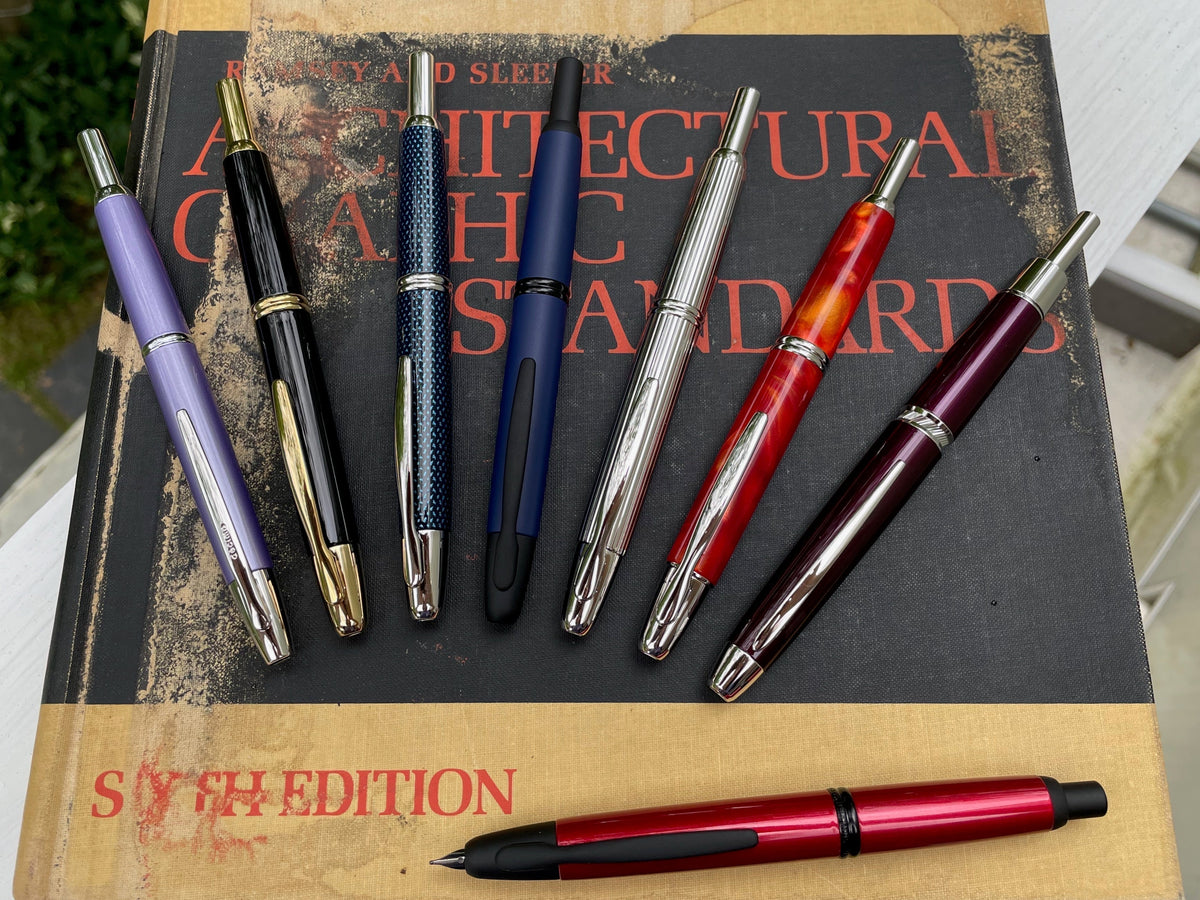
[Pictured left to right above is the complete MR Collection: MR Metropolitans in Plain Black, Plain Gold, Plain Silver, Gold Zig Zag, and Silver Dots; MR Retro Pops in Gray Houndstooth, Green Marble, Orange Flower, Turquoise Dots, Red Wave, and Purple Ellipse; and MR Animals in White Tiger, Crocodile (black), Leopard (plum), Lizard (bronzy gold), and Python (silver).]
MR actually stands for "Mid Range," and, although an MR is many people's first fountain pen, the collection is intended to be a little more elevated than a typical beginner pen, and to fill the tier between inexpensive pens and Pilot's most accessible gold nib fountain pens (such as E95s, Vanishing Point, and Custom 74).
My customers who pick up an MR often comment on the nice weight (27 grams), excellent balance, and solid, premium feel. The cap snaps closed with a satisfying click, and can post securely on the back of the pen if you want. Most MRs have a matte metallic finish that sparkles slightly when it catches the light. It's a well-built, high-quality design that looks great and stands up to years of use. Mine still looks almost as good as the day I bought it back in 2018!
 [Pictured: Gold Zigzag, Turquoise Dots, and Leopard MRs.]
Each of the three MR Collection subsets has its own distinct style:
1) The Metropolitan collection consists of elegant and sophisticated-looking modern classics, available in five styles, three with matching glossy bands, and two with bands decorated with a subtle pattern. The plain black version is available with a Calligraphy Medium 1.0 mm stub nib (CM), in addition to the Fine (F) and Medium (M) options that the others come in.

[Pictured: Pilot Metropolitan in Plain Black.]
2) The Retro Pop collection was inspired by the vibrant colors, energy, and motifs of the late 1960s and 1970s. The middle bands on these six pens feature a cool pop art pattern. I love the fun designs and nice colors. This whole series is available with the Calligraphy Medium (CM) nib, in addition to the Fine (F) and Medium (M) options.

[Pictured: Retro Pop pens in Orange Flower, Green Marble, Gray Houndstooth, Turquoise Dots, Purple Ellipse, and Red Wave.]
3) If you want to express your wild side, the Animal collection is the one for you! This series has more subdued colors, but features a different exotic animal print on each accent band.

[Pictured: MR Animal pens in Leopard (plum), White Tiger, Lizard (bronzy gold), Python (silver), and Crocodile (black).]
The Tiger, pictured below with the Black Metropolitan and Purple Ellipse Retro Pop, has a glossier pearlescent finish that's different from the matte metallic finish on all the other pens. It's subtle but quite attractive! It feels smoother and warmer, like you are touching enamel instead of metal.
 [Pictured: Plain Black, Purple Ellipse, and White Tiger MRs.]
The MR has a more tapered body than the Kakuno and Explorer, so it uses the smaller CON-40 converter. For greater convenience, you can also just pop in a Pilot or Iroshizuku ink cartridge. It comes with both a converter and cartridge to get you started.

[Pictured: MR with Pilot cartridges ready to load.]
With their classic torpedo shape, the MR Collection pens resemble many other well-known pens that are much higher priced, such as the Sailor 1911, Esterbrook Estie, Pilot Custom 74, 743 and 823, Diplomat Elox, and Montblanc Meisterstuck. It's a great entry point to the world of more sophisticated fountain pens, and, depending on color choice, wouldn't look out of place in a suit pocket or a young person's pencil case.
TWSBI Eco
If I sense that a new fountain pen user is a little more adventurous, wants to write with shimmer inks, or loves seeing how things work, I show them the TWSBI cabinet and its array of fun piston-filling fountain pens with transparent barrels.
TWSBIs are very well-loved at Pen Boutique, both by customers and among my co-workers, and the Eco (short for "eco-nomical") model in particular is a popular entry-level fountain pen and collector pen. Every time a new color is released, TWSBI fans get excited and come into the store asking to see it. The Eco is only $36.99 for standard models, and prices go up to a little under $60.00 for releases with special resin and/or trim.
 [Pictured: TWSBI Eco in Black Marble with Bronze Trim.]
The transparent barrels and interesting cap and finial colors inspire ink lovers to get creative with mixing and matching their favorite inks to the pens, so, more often than not, my TWSBI-loving customers walk out with a fun new pen to add to their collection and brighten their day. As one of our regulars put it, "My mother always said, 'If you have a bad day, go buy a lipstick.' But instead, I go buy a TWSBI." Although TWSBI Ecos are known to be a little addictive, there is no reason to feel like you need to buy more than one! Start with your favorite color and enjoy that before deciding where you'd like to go next on your fountain pen journey.
Since the Eco is a piston-filler, it doesn't use cartridges or a converter, but fills directly from an ink bottle into the barrel of the pen. That may sound a little scary, but it really isn't any harder than using a converter. All you have to do is twist the knob at the end of the barrel counter-clockwise to extend the piston, submerge the nib in ink, then screw the knob back shut to retract the piston, drawing ink into the pen from the bottle. With a capacity of approximately 1.5 ml to 1.8 ml, the barrel of an Eco holds a lot of ink--more than double the volume of a Standard International ink converter or cartridge. If you're planning to use one ink in your pen for a long time without changing colors, this is a great feature. You'll be able to write for a very long time without running out! I personally never feel the need for a huge ink capacity, but people who write a lot really appreciate this feature.
TWSBIs use nice smooth nibs that are available in Extra Fine, Fine, Medium, Broad, and 1.1 mm Stub widths, and a lot of customers love owning them in a variety of nib sizes so they can use different TWSBIs with different inks and for different purposes. Broad and Stub nib Ecos are especially popular for people who like to experiment with shimmer inks because they don't easily clog and because it's so beautiful to see your pretty ink glistening inside the barrel. Extra Fine, Fine, and Medium are perfect as daily writers, and customers love keeping different ink colors in each pen, so they have a selection to inspire them as they go about their week. TWSBIs write significantly thicker and wetter than Japanese pens like a Pilot, Sailor, or Platinum, because they use German nibs, so if you have small handwriting, you'll probably prefer a Fine or Extra Fine.

[Pictured: TWSBI Eco in Root Beer with Bronze Trim.]
There are two different types of Eco: the regular Eco and the Eco-T. The Eco-T has a rounded triangular shaped cap and end finial, while the regular Eco's design is hexagonal. The Eco-T also has a slightly more pronounced grip section. TWSBI says this grip section is perfect for beginner writers learning proper grip, new writing enthusiasts, and anyone who prefers a more structured grip. I think they are both comfortable, and a lot of people never really notice any difference.

[Pictured: Eco-T on the left, and Eco on the right.]
When I first started at Pen Boutique, TWSBIs intimidated me because the packaging includes a wrench, silicone grease, and a manual with pictorial instructions showing you how to take it apart and service it. Yes, I work in a fountain pen store, and I love pens, but my brain is good at knowing how to make sentences flow, not at understanding how physical objects fit together structurally. Later, after talking to many happy TWSBI owners, I realized that there is no need to disassemble your TWSBI unless you're completely comfortable doing so. It isn't necessary for routine cleaning and maintenance. Tinkerers love the opportunity to understand more fully how their pen works, and some people love to give their pens a very thorough cleaning, but, if that's not you, don't feel pressured to do so just because the tools and instructions are available. I took my TWSBI apart one time (with guidance) for a blog article, then never did it again! Now I don't hesitate to recommend an Eco to a new fountain pen user who likes the look of the pen and wants to have fun with ink.

[Pictured: TWSBI Eco fountain pen with instructions for filling and disassembly/reassembly.]
Kaweco Sport
The Pilot Kakuno, Kaweco Perkeo, Pilot Explorer, LAMY Safari and AL-Star, Pilot MR, and TWSBI Eco are my top go-to pens to recommend to new fountain pen users. Sometimes I come across customers who don't quite connect with these pens, though. And, often, a new enthusiast will try one or more of the pens on my initial list, then want to branch out to something a little different, but still low priced and user-friendly. That's when I show them a few more alternatives.
The Kaweco Sport ($34.00-$36.00 for most ABS plastic models) is a fun and compact pen that's simultaneously playful and utilitarian. When capped, it will fit in the palm of your hand, but, when the cap is posted on the end of the pen, the Sport expands to full size for writing and is almost the exact same length as a LAMY AL-Star or Safari with their caps not posted. However, it still has a pretty small grip section, so users with larger hands can find the Sport uncomfortable. It's only 9 grams, and the capped length is 10.6 cm / 4.2 inches, while the posted length is 13.1 cm / 5.2 inches, so some people find it too small or too lightweight.

[Pictured: Kaweco Sport in my hand.]
The Sport has plenty of loyal followers, though! It was created more than 100 years ago, in 1911, as a sturdy pocket-sized fountain pen for sportsmen that could be carried everywhere. The famous octagonal design was introduced in 1935, and today's Sport still closely resembles its earlier incarnations. It's another one of those pens that's irresistible to collectors because it's inexpensive, cute, and comes in so many great colors.
The pen's barrel and grip section are cylindrical, but the cap is octagonally faceted, a design detail I love. The facets feel nice if you lightly twirl the pen between your fingers, and also keep it from rolling away when you place it down on a flat surface. They also make the pen easy to grab onto, and catch the light in interesting ways, giving each surface of the pen its own highlights and shadows.
It's easy to get confused about the plastic Sport's different lines, so here's a quick rundown: the Classic Sport has gold-colored details and gold-colored steel nibs; the Skyline Sport has silver detailing and silver-colored steel nibs; and the translucent Frosted Sport (discontinued but still available in limited quantities) comes in six fruit-inspired colors with silver detailing. Kaweco also releases limited-edition Collector's Edition colors each year, which are based on the regular Sport designs but are available only while supplies last.
 [Pictured: Kaweco Collection Sport in Marble Ocean Green, pictured with Kaweco's foldable mini converter.]
The variety of colors available in the Sport lineup is delightful, and the pen has so many different personalities depending on which color you choose and how you accessorize it. Optional clips can slide onto the cap and give your pen a whole new look and functionality, and some collectors even enjoy combining different colors to create their own combinations.

[Pictured: Kaweco Classic Sport in Green, Skyline Sport in Fox Red, and Frosted Sport in Light Blueberry.]
Yes, it's only plastic, but it's got a great personality that makes people smile! It's also a tough little pen and I love how lightweight and portable it is. This is a true pocket pen and can be safely stashed just about anywhere. The screw cap is extremely secure and I never worry about throwing it in my mini backpack or bringing it on a walk through the woods in the rain. Kaweco also makes metal Sports, which are much heavier and quite a bit pricier, but I wouldn't recommend those for beginners.
The Sport's nib is a little smaller than the one on the Perkeo, and is available in sizes ranging from Extra Fine to Double Broad (BB). You can also get spare nib units in a variety of colors, styles, and materials. There's a tiny folding converter that fits the Sport, or you can use Standard International short cartridges, which are available from many different brands. The mini converter doesn't hold a lot of ink, but it works quite well!
Monteverde Ritma
When I have a customer who thinks every entry-level pen I've shown them is too lightweight, I have one more trick up my sleeve: the Monteverde Ritma. At $55 for most models, it's the most expensive pen on this list, but it's made from anodized aluminum and steel, and has a very well-built, sturdy feel. It also comes with a converter installed, as well as two cartridges to get you started. At 50 grams, this is by far the heaviest pen on my list--almost twice the weight of the 27-gram Pilot Metropolitan and more than three times the weight of the 15-gram LAMY Safari! Even the grip section is metal.

[Pictured: Ritmas in Walnut, Turquoise, and Mimosa.]
The Ritma was inspired by the clean lines of 1960s and ’70s design and has a sleek cylindrical shape, including an uncontoured grip section that can be too straight and slippery for some people. It comes in a huge range of beautiful color options and features a magnetic cap that slides into place with a satisfying click and is definitely a big part of its appeal. People love that cap! The magnets work just as well for posting the cap on the end of the pen as they do for using it to cover the nib, although posting the cap can make the pen feel too heavy for some people, especially for longer writing sessions. The weight that feels comfortable to you is a very personal thing, though--some people find lightweight pens tiring to hold and love the secure feeling of a heavy pen's weight in their hand. This is something that's best to get a feel for in person if you live close enough to a pen store.

[Pictured: Ritma fountain pen and ballpoint in Purple.]
Like Kaweco, Monteverde uses Standard International cartridges, so you have lots of options if you'd like to stick to the ease of cartridges, but you can also enjoy bottled inks with the converter.
The Ritma's colors range from edgy matte carbon fiber, sleek black, and brushed stainless steel to vibrant jewel tones like purple, yellow, and turquoise, and there is even a walnut version made from real wood.
The Ritma's German nib is a smooth and wet writer, available in Extra-Fine, Fine, Medium, Broad, 1.1 mm Stub, and even Omniflex, which flexes slightly for variation in line width. I'd recommend the Fine or Medium for beginners, or Extra-Fine if you write very small.
Finding the Right Pen for You
Choosing your first fountain pen doesn't have to be complicated. You don't need to know exactly what nib, filling system, shape, or style you prefer before you begin. Start with a pen that appeals to you, feels comfortable in your hand, and fits your budget. You can learn the rest as you go.
And remember, your first fountain pen doesn't have to be your last. It may be the beginning of a collection, or it may simply become the reliable pen you reach for every day. Either way, I hope this guide helps you find one that makes you excited to write. If you were in the store buying your first fountain pen from me, I'd be so happy for you. And I would tell you with a big smile: "Congratulations! Enjoy!"
-Laura P.
I love comments on my blog! Please leave comments if you like the articles, and, if you have any questions about this article, or any of the other blog articles, you can e-mail support@penboutique.com. Thank you!


14 comments
John B
Thanks again, Laura. One of my almost daily pleasures is to keep a journal/notebook with quotes; a fountain pen seems specilly suited for this. I was thinking of that quote “better to keep silent and be thought a fool, than to speak and remove all doubt” when reading comments that correct others spelling … and get the spellng wrong themselves. 🙂 https://www.penboutique.com/collections/sheaffer-fountain-pens
Thanks again, Laura. One of my almost daily pleasures is to keep a journal/notebook with quotes; a fountain pen seems specilly suited for this. I was thinking of that quote “better to keep silent and be thought a fool, than to speak and remove all doubt” when reading comments that correct others spelling … and get the spellng wrong themselves. 🙂 https://www.penboutique.com/collections/sheaffer-fountain-pens
Randy
Great article, Laura! Bought my first fountain pen less than a year ago, but quickly tried out several of the pens you featured here. The ones I haven’t tried yet are going on my wish list for my birthday! Keep up the great posts!
Great article, Laura! Bought my first fountain pen less than a year ago, but quickly tried out several of the pens you featured here. The ones I haven’t tried yet are going on my wish list for my birthday! Keep up the great posts!
John R. Mecklenburg
Laura –
Great article…thanks so much for taking the time to outline so thoroughly this topic.
A couple of quick thoughts…I believe than any “first time” fountain pen user should begin with a “cartridge refill” pen, for ease of use and to keep everything as simple as possible. Just my opinion.
And I like a pen with some “heft,” not a lightweight plastic pen.
That being said, I would usually give a friend a Scheaffer 100 (medium nib) pen as a first effort. The cost is reasonable and it has some weight to it.
Finally, I’m also surprised how many people who like Scheaffer pens (see comments above), don’t know how to spell it.
Keep up the good work…
Laura –
Great article…thanks so much for taking the time to outline so thoroughly this topic.
A couple of quick thoughts…I believe than any “first time” fountain pen user should begin with a “cartridge refill” pen, for ease of use and to keep everything as simple as possible. Just my opinion.
And I like a pen with some “heft,” not a lightweight plastic pen.
That being said, I would usually give a friend a Scheaffer 100 (medium nib) pen as a first effort. The cost is reasonable and it has some weight to it.
Finally, I’m also surprised how many people who like Scheaffer pens (see comments above), don’t know how to spell it.
Keep up the good work…
William Cowell
Hello Laura,
I read your article with some interest. It covers quite a variety of pens. Unfortunately, I believe there is too much information here. It it would be confusing to one who wanted for the first time to use a fountain pen. Over the years I have been asked and always recommend Lamy safari. It is, or at least was, very popular in Europe. It is also a pen which is not terribly expensive. Yet, if you decided continue using a fountain pen you will have a good quality pen you will not have to hurry to replace. I might say that I have been using a fountain pen for 67+ years – since grade school. I suppose that it is also is pertinent that I am a member of the Pen Collectors of America. But I will also say – Keep Writing
Hello Laura,
I read your article with some interest. It covers quite a variety of pens. Unfortunately, I believe there is too much information here. It it would be confusing to one who wanted for the first time to use a fountain pen. Over the years I have been asked and always recommend Lamy safari. It is, or at least was, very popular in Europe. It is also a pen which is not terribly expensive. Yet, if you decided continue using a fountain pen you will have a good quality pen you will not have to hurry to replace. I might say that I have been using a fountain pen for 67+ years – since grade school. I suppose that it is also is pertinent that I am a member of the Pen Collectors of America. But I will also say – Keep Writing
Andrew Brown
One other that might be useful – Platinum Plaisir – I find them really smooth (depending on ink obviously) and a nice size.
One other that might be useful – Platinum Plaisir – I find them really smooth (depending on ink obviously) and a nice size.
Andrew Brown
Hi Laura, You have captured the subject perfectly. I have used fountain pens all my life from 11 years old and after years with the more expensive varieties, discovered JAPAN! I have a 40 year old Namiki Falcon with very flexible nib but my pen box is full of Kaweco, kukuno & Lamy. The kukuno’s with fine nibs are perfect! My only disagreement is TWSBI – I find them low quality and the plunger breaks easily. Great read!
Hi Laura, You have captured the subject perfectly. I have used fountain pens all my life from 11 years old and after years with the more expensive varieties, discovered JAPAN! I have a 40 year old Namiki Falcon with very flexible nib but my pen box is full of Kaweco, kukuno & Lamy. The kukuno’s with fine nibs are perfect! My only disagreement is TWSBI – I find them low quality and the plunger breaks easily. Great read!
frank vozak
I have been writing with a fountain for 65 years starting with a Shaeffrer with a series of Shaeffers and Parkers and then off to the Mont Blanc, Waterman, Pelikan, and Reform. I was amazed by the amazing student pens that Shaeffer, Parker, Pelikan, Waterman, and Reform offered.
I have been writing with a fountain for 65 years starting with a Shaeffrer with a series of Shaeffers and Parkers and then off to the Mont Blanc, Waterman, Pelikan, and Reform. I was amazed by the amazing student pens that Shaeffer, Parker, Pelikan, Waterman, and Reform offered.
Jim Jansdn
Thank you for this write up. Fountain pens can become a real adventure with levels upon levels …But it’s also quite an adventure in its most simple stage. I find it’s hard to talk about a fountain pen’s performance w/o mentioning the ink. Inks can definitely affect a pens performance, at least it does for me.
But there really is a sort of sensuality in writing with a fountain pen and I find it adds to the desire to write.
I’m glad the industry is still around and apparently thriving; by the way I still enjoy fly fishing with a bamboo/cane fly rod and I still use a Swiss movement wrist watch.
Thanks again
JJ
Thank you for this write up. Fountain pens can become a real adventure with levels upon levels …But it’s also quite an adventure in its most simple stage. I find it’s hard to talk about a fountain pen’s performance w/o mentioning the ink. Inks can definitely affect a pens performance, at least it does for me.
But there really is a sort of sensuality in writing with a fountain pen and I find it adds to the desire to write.
I’m glad the industry is still around and apparently thriving; by the way I still enjoy fly fishing with a bamboo/cane fly rod and I still use a Swiss movement wrist watch.
Thanks again
JJ
Jim Jansdn
Thank you for this write up. Fountain pens can become a real adventure with levels upon levels …But it’s also quite an adventure in its most simple stage. I find it’s hard to talk about a fountain pen’s performance w/o mentioning the ink. Inks can definitely affect a pens performance, at least it does for me.
But there really is a sort of sensuality in writing with a fountain pen and I find it adds to the desire to write.
I’m glad the industry is still around and apparently thriving; by the way I still enjoy fly fishing with a bamboo/cane fly rod and I still use a Swiss movement wrist watch.
Thanks again
JJ
Thank you for this write up. Fountain pens can become a real adventure with levels upon levels …But it’s also quite an adventure in its most simple stage. I find it’s hard to talk about a fountain pen’s performance w/o mentioning the ink. Inks can definitely affect a pens performance, at least it does for me.
But there really is a sort of sensuality in writing with a fountain pen and I find it adds to the desire to write.
I’m glad the industry is still around and apparently thriving; by the way I still enjoy fly fishing with a bamboo/cane fly rod and I still use a Swiss movement wrist watch.
Thanks again
JJ
Harry Shaw
I’m going to “me too” Jonathan’s comment above. I would really enjoy your take on fountain pens from starter pens to the more luxurious. Might even think of including a look at new pens in each blog post. Or not. Very nice read indeed.
I’m going to “me too” Jonathan’s comment above. I would really enjoy your take on fountain pens from starter pens to the more luxurious. Might even think of including a look at new pens in each blog post. Or not. Very nice read indeed.
Jonathan Ash
This was a very interesting write-up for beginners but also for those who have far surpassed the beginner pen level.
I would love to see you “walk up the ladder” of better and Herrera pens (or most likely more and more expensive pens) telling readers what they can expect as they
“Graduate” in pens up too the luxury pens. This could be done in several installments or one long article. I always read your articles and find them interesting.
Just keep on producing them, they are wonderful.
As always,
Jon
This was a very interesting write-up for beginners but also for those who have far surpassed the beginner pen level.
I would love to see you “walk up the ladder” of better and Herrera pens (or most likely more and more expensive pens) telling readers what they can expect as they
“Graduate” in pens up too the luxury pens. This could be done in several installments or one long article. I always read your articles and find them interesting.
Just keep on producing them, they are wonderful.
As always,
Jon
Lloyd TATE
One pen you should have included is the PelikanTwist. It’s a great starter pen and it has a good quality nib.. I actually started with Lamy Safari and probably have at least 3 dozen, probably more. I’ve collected many of the various colours over the years. They are a great writing pen, the only pens I have I like better for writing are my Pelikan 200 series. That includes my Mont Blanc and several others with gold nibs. My favourite pen is my Viscounti Homo Sapiens ( the lava body is beyond words for feel ) but it’s a bit of a pain to fill it. I’m pretty sure if my wife knew how much money I’ve spent on fountain pens along with the dozens of Retro 51s she’d have me committed.
One pen you should have included is the PelikanTwist. It’s a great starter pen and it has a good quality nib.. I actually started with Lamy Safari and probably have at least 3 dozen, probably more. I’ve collected many of the various colours over the years. They are a great writing pen, the only pens I have I like better for writing are my Pelikan 200 series. That includes my Mont Blanc and several others with gold nibs. My favourite pen is my Viscounti Homo Sapiens ( the lava body is beyond words for feel ) but it’s a bit of a pain to fill it. I’m pretty sure if my wife knew how much money I’ve spent on fountain pens along with the dozens of Retro 51s she’d have me committed.
Terence GF Flynn
I have cut out images from the paper sheets that arrive with the fountain pens, especially the Kakuno sheets and others of course.
I save magnetic advertising pieces and use them to attach the images to, then carefully cut them free.
These fountain pen image magnets make grand refrigerator pieces for oneself or for others.
One really only needs to keep 1 copy of each sheet for reference.
My first fountain pens were Preppy, Shark and then the Metropolitan all Black.
I know you prep your hands before a photoshoot, as one should, but as I have stated before, Grand Hands.
I have cut out images from the paper sheets that arrive with the fountain pens, especially the Kakuno sheets and others of course.
I save magnetic advertising pieces and use them to attach the images to, then carefully cut them free.
These fountain pen image magnets make grand refrigerator pieces for oneself or for others.
One really only needs to keep 1 copy of each sheet for reference.
My first fountain pens were Preppy, Shark and then the Metropolitan all Black.
I know you prep your hands before a photoshoot, as one should, but as I have stated before, Grand Hands.
John B
Hi Laura, always enjoy reading your blog. I am a dinosaur who learned to write in cursive in 2nd grade with a Shaeffer fountain pen. I could not agree more that the Kakuno is an abolute delight! It was my first re-entry into fountain pens, and I still use it daily. I’m still at the point where my modest collection doesn’t have a pen that cost over $100 – the TWSBI Eco Root Beer is my splurge – but those two pens alone will give any new enthusiast a wonderful adventure into fountain pens. Thanks for keeping things interesting with your blog.
Hi Laura, always enjoy reading your blog. I am a dinosaur who learned to write in cursive in 2nd grade with a Shaeffer fountain pen. I could not agree more that the Kakuno is an abolute delight! It was my first re-entry into fountain pens, and I still use it daily. I’m still at the point where my modest collection doesn’t have a pen that cost over $100 – the TWSBI Eco Root Beer is my splurge – but those two pens alone will give any new enthusiast a wonderful adventure into fountain pens. Thanks for keeping things interesting with your blog.